
Confederate apologists often claim, as Nikki Haley did during the 2024 Republican primary campaign, that the Civil War was fought over “states’ rights.” The Southern rebellion was indeed about “states’ rights,” but only in the sense that it was about the Confederate States’ right to determine who was an American citizen and interpret the Constitution to its own satisfaction. That’s why Confederates inverted their secession as the “The War of Northern Aggression.”
The sources of today’s crises come into focus once we understand that we are well into a war of Southern aggression—a neo-Confederate project to remake the entire country in its own image and win the war the South never conceded. As I’ve long argued, there is a geographically distinct “nation” within the American nation — the Neo-Confederate States — that refuses to accept the legitimacy of the United States as the pluralistic democracy that the rest of the country aspires to be. (Endnotes: Nation within the nation1, boundaries2.)
Seen in this light, the brutal invasion of Minnesota is not an aberration, but the most recent maneuver in the MAGA military reconstruction of the North, a coordinated assault on not just the idea of liberal democracy, but on those living in states that, however imperfectly, still strive for it.
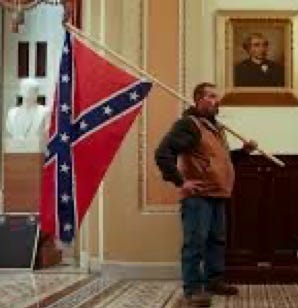
The MAGA Reconstruction
Capital-R Reconstruction was a high point in American history precisely because it was the moment when the nation insisted—by force if necessary—that the defeated Confederate states accept the legitimacy of the United States, the supremacy of federal law, and the political equality of those they had enslaved.
Violent Southern resistance to that project—most notably the formation of the Ku Klux Klan and the systematic use of terror, murder, and intimidation to prevent Black Americans from registering, voting, or holding office even after being elected—made military Reconstruction unavoidable. Federal power was deployed to reconstruct the South so that it would conform, in fact and not merely on paper, to the Thirteenth, Fourteenth, and Fifteenth Amendments.
What we are witnessing now is something I deliberately denote as reconstruction with a lowercase “r.” It borrows the tools of Military Reconstruction—federal force, occupation, administrative override—but inverts their purpose. Instead of enforcing freedom and civil rights, it is used to strip them away; instead of seeking to subject an authoritarian region to democratic order, it seeks to subjugate a democratic region to an authoritarian order. The symmetry is intentional. It is meant to underscore both how deeply rooted today’s aggressors’ ambitions are in American history, and how radically different the moral stakes are.
The resistance to Reconstruction took the form of murderous guerrilla warfare and lynch mobs determined to restore a racial caste system. The ongoing resistance to MAGA reconstruction takes the form of nonviolent heroism—by people who have placed the freedom and human dignity of their neighbors above their own safety. That contrast is the point. It is the clearest measure of what is being undone, and of what is now at stake.
The Neo-Confederate Agenda
What is the MAGA reconstruction intending to achieve? It is not the shambolic but deadly project we are continuing to be told it is, nor is it a “partisan” project in the sense that I’ll come back to, nor does it fit in the familiar model of a personalist strongman enterprise. To recognize the project’s core animating intentions one has only to look at the authoritarian and Christian nationalist measures enacted by Neo-Confederate states within their borders, and what the Roberts Court has already accomplished in terms of privileging Christians and giving “Christian” values the color of law, overturning the gains of the civil rights movement, and much more (as I wrote in detail in To the Supreme Court, the 20th Century Was Wrongly Decided).
Much of Project 2025 was less the product of the imagination of DC think tankers than a compendium of what Neo-Confederate states have already enacted within their borders. Those states continue to be “laboratories of autocracy” supplying the Trump regime with the tested and honed policies and personnel that were lacking in Trump 1.0.
The following table shows how the vast bulk of what Trump has been doing had already been enacted in similar form by neo-Confederate state legislatures, having either been enabled or facilitated by the Roberts Court. Nearly all of the present MAGA agenda had been, or was on its way to being, accomplished in Neo-Confederate America even before Trump descended the golden escalator in 2015. See The Two Nations of America for how Blue states have been acting in each of these areas. You can click on the chart below to see the details.

To be clear, that is not to dismiss Trump’s egregious grifts or side projects like tariffs, but to understand that he has grafted those grifts onto the project that was well underway before he took office, and will continue after he has left office.
The MAGA Reconstruction Is Not a Partisan Project
We must understand that we have arrived at this moment not because Donald Trump or the Republican Party won the hearts and minds of a national electorate, but because organized interests concentrated in a single geographic region have spent the past two decades capturing the nation’s governing institutions. Once we recognize the House and Senate Republican caucuses, the Roberts Court majority, and Donald Trump himself as instruments of a sectional oligarchic project, the collapse of checks and balances—and the systematic weaponization of federal power—becomes not only intelligible, but predictable.3
Now, let’s consider the actions of the Trump regime that make no sense if the objective is winning elections, but make all the sense in the world if the objective is the MAGA reconstruction of the rest of America and if the MAGA worldview is taken literally — in other words, how people behave when they truly believe down is up.
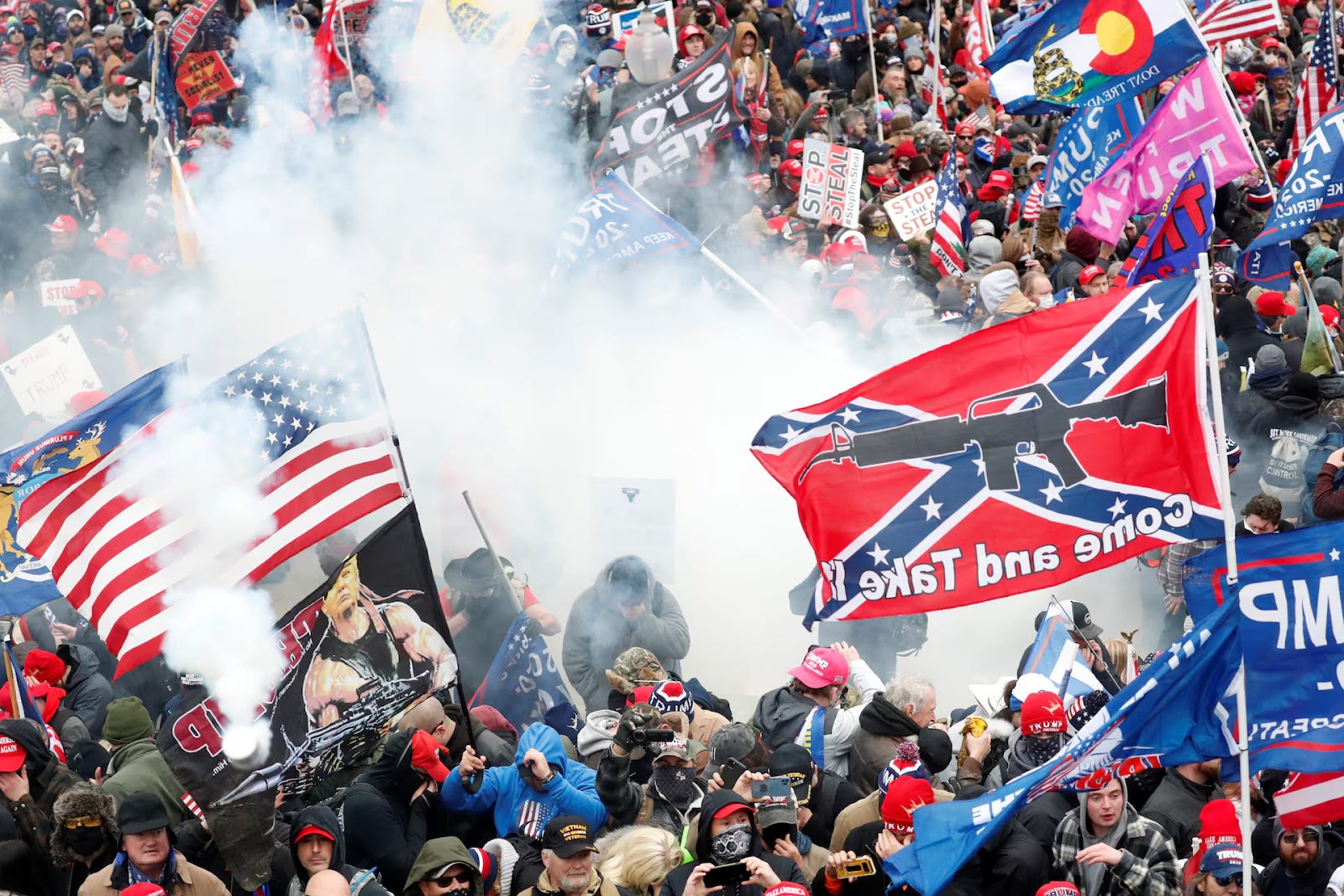
January 6th pardons.
If the 2020 election had actually been stolen from Trump, it would be irrational for him not to pardon those who risked so much to “save” democracy on January 6th, or to allow those who went along with the “stealing” of the election to remain in public office. It would be somewhat akin to the original Continental Congress not freeing those jailed by the British after declaring independence. Second, especially in the context of the Roberts Court immunity decision, both of those actions sent a clear message to everyone that no action taken on behalf of the Trump Regime would be too extreme to be pardoned and no action taken against it too small to evade penalty.4
FBI and DOJ purges.
Over the last year we have applauded the integrity of those in the Department of Justice and the FBI who have resigned rather than undertake a wide variety of actions, from corruptly dismissing charges against Eric Adams to opening up an investigation of Renee Good. In the down is up MAGA world, where the election had been stolen and seeking to hold Trump accountable was the partisan weaponization of the Justice Department, being told to investigate Trump should have brought the same response, and they have as much regard for those who carried out those projects as we might have for prosecutors who stayed to build a case against Renee Good, for example.
Attacks on elected Democratic politicians.
Crucially, the stolen-election myth does not draw its power from claims that Democrats stuffed ballot boxes or manipulated vote totals. It draws its force from a deeper presumption: that Democratic victories are invalid because they rest on the political equality of people who, in the neo-Confederate worldview, are not entitled to the same standing in the polity as white Christians. The 2020 election was a fraud not because the votes were miscounted but because of whose votes were allowed to count, meaning that elected Democrats are not political opponents but the “enemy within” — a subversive threat to the “real” America. Kristi Noem made this logic explicit when she described Los Angeles as a city in need of “liberation” from its elected leaders—leaders portrayed not merely as misguided, but as alien usurpers imposing illegitimate values. Trump made these intentions known throughout the campaign if anyone cared to take him seriously.5

Over the top attacks on DEI.
These attacks are well understood in terms of their rhetorical appeal to MAGA’s white Christian nationalist base and their priority of reclaiming what it means to be American. Not recognized, though, is their instrumental value — a wholesale warrant to purge the military, federal law enforcement, the federal government, and civil society institutions of the leaders who the regime believes are most likely to stand up to it. Nearly unreported was the resistance from Republican members of Congress to the Biden Administration’s efforts to weed out white nationalists embedded in the military and federal law enforcement.6

Renee Good and Alex Pretti smeared as domestic terrorists.
Especially since 9/11, the Bush, Obama, Trump and Biden Administrations developed, refined and deployed counter-insurgency tactics for controlling hostile urban populations around the world which are being deployed now in Northern cities. These tactics have four principles: (1) obtain total information (think Palantir, etc); (2) eradicate the active resisting minority; (3) gain the allegiance or passive acceptance of the general population; and (4) make credible the ability to terrorize with impunity.7 To be clear, that ICE is incompetent in conventional law enforcement techniques does not mean they are incompetent at executing this strategy; in some ways their thuggish lawlessness is precisely the point. (Thus, calls for “better training” are unlikely to solve our problems.)
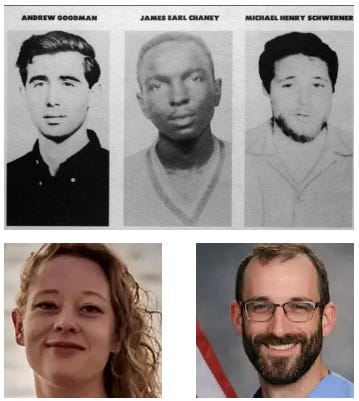
It’s important to note that these tactics have long been deployed against communities of color and movements for justice without attracting the same national attention and outrage. Furthermore, it’s far from unprecedented to see the murder of law abiding white citizens exercising their constitutional rights. During the mass resistance in the South to the civil rights movement, police murdered or gave the Klan and their allies free rein to murder activists including Andrew Goodman, Michael Schwerner, James Chaney, Viola Liuzzo, James Reeb, Jonathan Daniels, William Lewis Moore, and journalist Paul Guihard. And those murders went unpunished.
Coming Next:
This is the first of two parts. Today’s edition laid out the basic ideas of the MAGA reconstruction. Part II will be a data rich edition that takes apart the most persistent fictions in American political analysis: that national public opinion, rather than geography and institutions, is what actually sets the direction for the country. In this new context, the Roberts Court and congressional Republicans’ behavior make clear sense. The piece maps the real architecture of American power—and why so many people keep misreading both Trump’s strength and the danger we’re in.
Weekend Reading is edited by Emily Crockett, with research assistance by Andrea Evans.
ENDNOTE: Nation within the nation.
Until roughly the passage of the Voting Rights Act, it was widely understood that, as Bateman, Katznelson and Lapinski put it in their Southern Nation: Congress and White Supremacy after Reconstruction:
The defining characteristic of southern politics in the national arena was a willingness to subordinate the considerable diversity of policy priorities in the region to the paramount need to maintain local control of the South’s racial order.
That the South was a distinct polity with its separate culture, literature, racial order and political economy was more or less settled thoroughly in such works as Southern Politics in State and Nation (V. O. Key Jr.), The Southern Political Tradition (Michael Perman), Politics and Society in the South (Earl Black and Merle Black), The Rise of Southern Republicans (Earl Black and Merle Black), The New Southern Politics (J. David Woodard), The New Politics of the Old South (Charles S. Bullock III and Mark J. Rozell, eds.) and American Federalism: A View from the States (Daniel J. Elazar).
That view was discarded too quickly and optimistically as too much was read into the ascendance of politicians like Bill Clinton, as works like Deep Roots documented:
… Southern whites who live in areas where slaveholding was more prevalent are today more conservative, more cool to African Americans, and more likely to oppose race-related policies that many feel could potentially help blacks. That is, we demonstrate a direct connection between a long-abolished economic institution and contemporary political attitudes. That this connection has lasted over 150 years presents a puzzle for when and how the attitudes within the South diverged along these lines and why they have persisted until today. (Acharya, Avidit; Blackwell, Matthew; Sen, Maya. Deep Roots: How Slavery Still Shapes Southern Politics (Princeton Studies in Political Behavior Book 6) Kindle Edition.
ENDNOTE: Boundaries.
In previous writings, I have referred to the Neo-Confederate States as the illiberal “Red Nation” opposed to a liberal “Blue Nation.” But those color-jersey labels don’t capture the relevant dynamics of the Neo-Confederate States’ posture of rebellion, conquest, and refusal to accept the legitimacy of the United States. In this and following pieces, I will have to use several boundaries for what I’m conceptually identifying as the regional foundation on the march.
Southern states/Confederacy: I use these terms for the historic configuration. This is the generally accepted academic version, which begins with the eleven states of the Confederacy (Alabama, Arkansas, Florida, Georgia, Louisiana, Mississippi, North Carolina, South Carolina, Tennessee, Texas and Virginia) with four more which adopted severe Jim Crow regimes (Kentucky, Missouri, Oklahoma and West Virginia).
Neo-Confederate States: This is my preferred configuration, which adds states that are now aligned with the neo-Confederate project (Alaska, Arizona, Idaho, Indiana, Iowa, Kansas, Montana, Nebraska, North Dakota , Ohio, South Dakota, Utah and Wyoming) and drops Virginia. Note that in these states, while it is possible for Democrats to win statewide offices - as, for example, they have in Kentucky and North Carolina, those gubernatorial victories don’t threaten to reverse the neo-Confederate agendas already enacted in those states and protected by gerrymandered state legislatures.
Trump States/Harris States are obviously the states each won in the 2024 election.
Red/Purple/Blue states: I use this taxonomy when the data has to line up with state voting patterns in federal elections. Arizona, Georgia, Michigan, Nevada, North Carolina, Pennsylvania and Wisconsin are presidential battlegrounds and therefore “purple.” The remaining 43 states are red or blue based on whether they went for Trump or Harris.
To be clear, Donald Trump complicates the picture, because he was not the President that the Kochs and the other billionaires funding the Federalist Society, ALEC and all the other parts of their apparatus were hoping to clear the way for. His personal corruption and his erratic behaviour are why the Kochs and others held out until the bitter end behind Haley. But we make a mistake seeing the exceptions as proof the rule doesn’t exist.
Since the beginning of the Republic, presidents have actually enjoyed de facto immunity from prosecution after leaving office; there probably isn’t a president who hasn’t violated laws in the conduct of their duties. What has actually constrained presidents from unbridled lawlessness, especially after Watergate, is the criminal jeopardy of those being asked to carry out their crimes.
That expectation—more than abstract norms—kept presidential lawyers and senior officials in line. Moreover, as was illustrated by implication in the January 6 Committee hearings, even extreme political allies like Bill Barr were unwilling to go along with Trump after the election in the way he had been before the election, as there was still a view, most recently confirmed in the Mueller related prosecutions, that there could be severe penalties for following illegal presidential orders as there had been after Watergate for Attorney General John Mitchell and dozens of others.
In a March 2023 campaign rally in Iowa, where Trump pledged to deploy the National Guard in states and cities run by Democrats, specifically mentioning Los Angeles:
You look at these great cities, Los Angeles, San Francisco, you look at what’s happening to our country, we cannot let it happen any longer… you’re supposed to not be involved in that, you just have to be asked by the governor or the mayor to come in, the next time, I’m not waiting. One of the things I did was let them run it, and we’re going to show how bad a job they do. Well, we did that. We don’t have to wait any longer.
In the weeks leading up to the election, the Guardian and others wrote about how Trump had threatened to take military action against Democrat-run cities. The New York Times also published “If Trump Wins,” a sobering account of all the anti-democratic actions Trump had promised to take when he
returned to office—including that he would “unilaterally send federal forces to bring order to Democratic-run cities” and that he had “suggested using the military to handle ‘the enemy from within,’ whom he described as ‘radical left lunatics.’”
Republican members of Congress have repeatedly attacked and sought to defund Defense Department initiatives created after January 6 to identify and remove extremists from the ranks, denouncing them as “wokeism” and a partisan purge rather than a readiness issue. In 2021–2023, GOP lawmakers targeted the Pentagon’s Countering Extremism Working Group and its leader Bishop Garrison, pressured the department to scale back implementation of its recommendations, and pushed to cut related oversight and training lines in defense authorization and appropriations debates. Parallel Republican opposition in the Senate sank broader domestic terrorism legislation that would have strengthened coordination among DOJ, DHS, and FBI and required regular reporting on white supremacist and neo‑Nazi threats, including extremist infiltration of the military. Also, here and here.
See, for example the Petraeus Counterinsurgency Field Manual, Harcourt, Bernard E., The Counterrevolution: How Our Government Went to War Against Its Own Citizens and Schrader, Stuart. Badges without Borders: How Global Counterinsurgency Transformed American Policing
This is an excellent piece! It needs to be read by everyone in every Dem state, so that they understand how it really works and where it's coming from, and the role of the Robert's Court in facilitating it. Sharp analysis, most appreciated.
I absolutely can't wait for part 2, what an incredibly well written and thought out comparison.