On the day that the Roberts Court effectively killed what remained of the Voting Rights Act, I was lucky to have Amy Walter, publisher and editor-in-chief of The Cook Political Report with Amy Walter (subscribe to CPR on Substack here) as my guest on “Weekend Reading Live” to help make sense of what this means for the midterms and beyond.
Highlights included:
There should be limited impact on the 2026 midterms, Amy said, given things like filing deadlines and the risks of dummymandering in what will likely be a huge Democratic wave year. (But stay tuned; hours after our conversation yesterday, Gov. Jeff Landry announced he plans to suspend the primaries in order to redraw the maps — even though the Louisiana filing deadline has passed, mail ballots have already been sent overseas, and early voting was about to start.)
Check out Cook Political Report’s coverage on redistricting, including its Redistricting Tracker that has been updated to account for the Roberts Court ruling.
The real fight is 2028. We have every reason to expect Republican-controlled legislatures to aggressively redraw maps mid-cycle just like they’ve been doing, which Amy said will likely ramp up the pressure on blue states to respond in kind if they haven’t already. But blue states may have less room to maneuver, meaning that whatever happens ahead of 2028 will likely net to Republicans’ advantage.
Kafka would be jealous of the ruling in Louisiana v. Callais: it allows racial gerrymandering (of Black voters, who overwhelmingly vote Democratic) as long as it doesn’t interfere with a state legislature’s partisan goals.
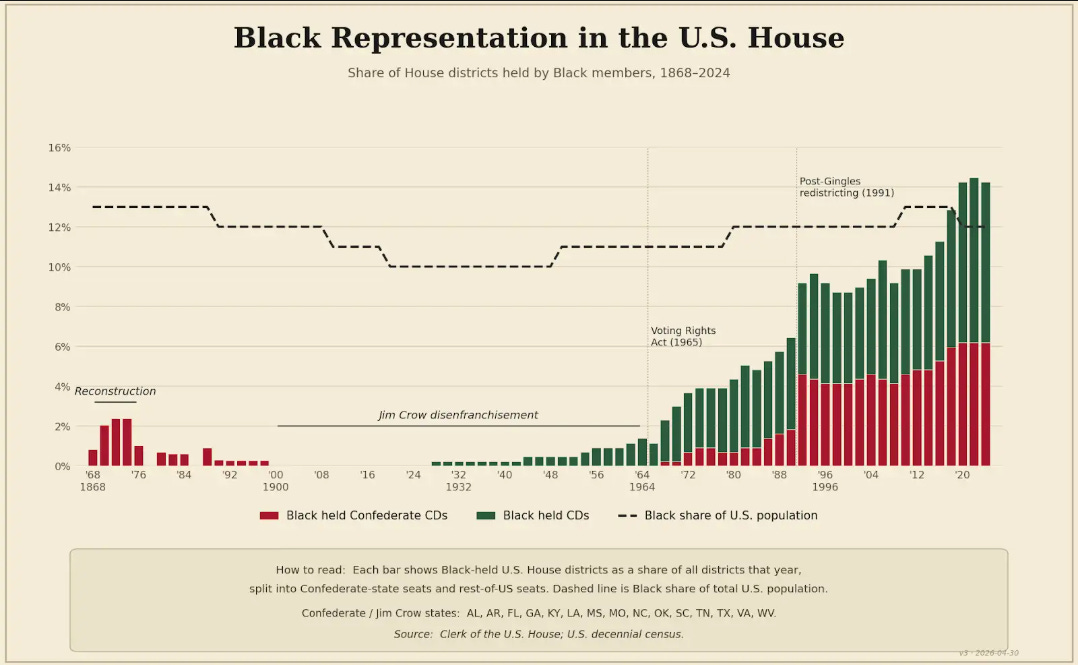
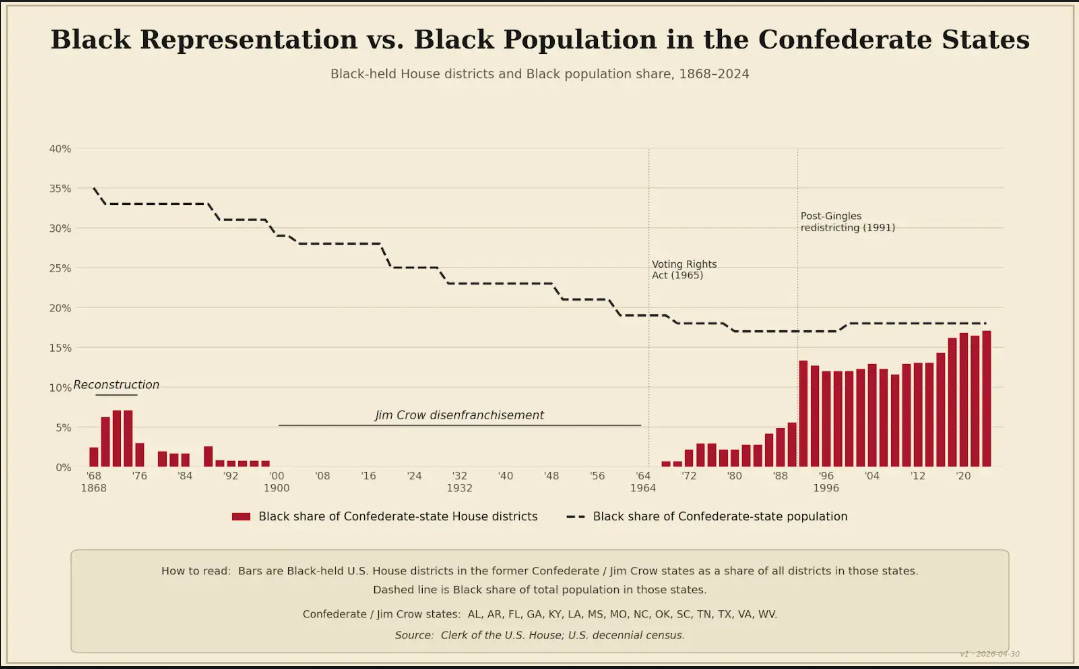
I presented data showing how dramatically Black representation in Congress increased, especially in the South, in 1992, the first election with majority-minority districts after Thornburg v. Gingles upheld Congress’s strengthening of the VRA to require them. Black voter participation skyrocketed almost immediately after the Voting Rights Act was enacted in 1965, but casting a ballot isn’t the same thing as having your vote count; Black people in the South rarely got to elect the candidates of their choice who would represent their communities’ interests.
The overall 2026 midterm landscape:
We discussed highlights from Cook Political Report’s latest polling of competitive House districts. The D+6 generic ballot suggests a roughly 8-point swing for Democrats from 2024 — which could easily be larger in many districts, especially if disillusioned non-MAGA Republicans stay home.
Plus, many Republican incumbents in gerrymandered districts have never run a real general election and lack the political infrastructure (consultants, TV ad experience, messaging discipline) to handle a competitive race.
The Senate: Amy said the four key pickup opportunities for Democrats, in order of most to least likely, are North Carolina, Maine, Ohio (more complicated because Sherrod Brown has a loyal cross-partisan voter base built over multiple elections), and Alaska (Mary Peltola has higher favorables and an outsider identity, making her competitive). Texas is a massive $500 million question mark. In Nebraska, Dan Osborn (running as an independent but coded as a Democrat) is a compelling candidate, but unlike 2024, Republicans won’t be caught off guard this time.
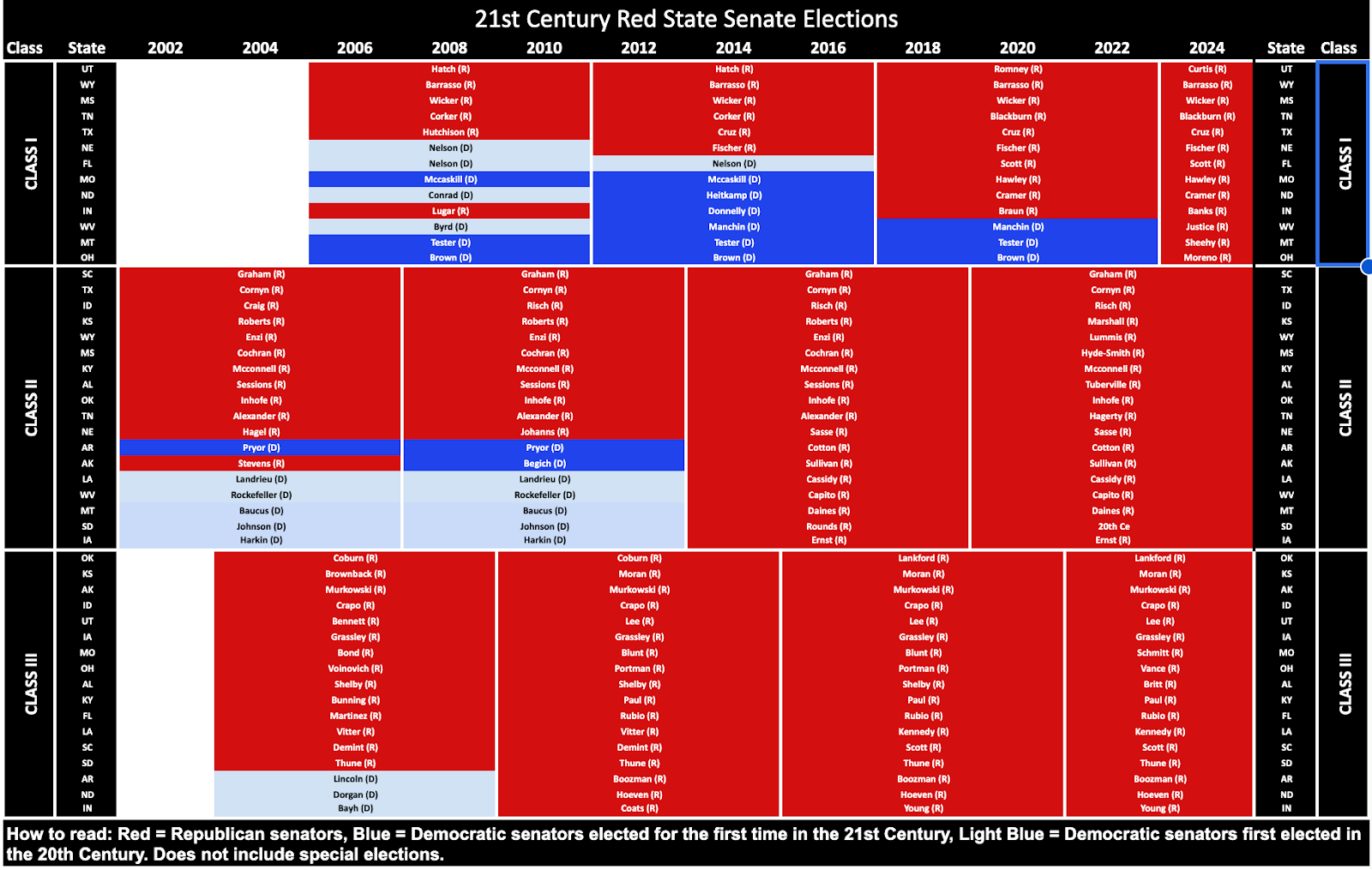
The key to victory for Democrats running for Senate in red states? Timing. Not moderate policies, not messaging tweaks. I presented data showing that in the 21st century, almost the only Democrats who have won Senate seats in red states were either pre-existing incumbents (light blue) or rode a wave year (2006, 2008, 2012). And 2026 could be just such a wave year.