
All signs point to the midterm results being what pundits will call a “blue wave,” if not a blue tsunami. But that name suggests voters are suddenly in love with Democrats, instead of what’s actually happening: a red wipeout, driven by the anti-MAGA majority that never actually went away. (For more on that, read my 2025 piece on “The Re-Emerging Anti-MAGA Majority.”)
But if you still hope that this time Republicans losing elections will “break the fever,” you will be disappointed again. We can be confident that a red wipeout will leave MAGA with even greater control of the Republican Party. I explained why in a deep dive yesterday on what I call “The Confederate Realignment”: a Republican Party today that’s just as regionally captured by one-party regimes as the Jim Crow South was by Democrats, enabled by a series of Roberts Court decisions that I call “the Roberts Rules.” (More highlights from that post below.)
Here are some charts you should keep in mind as the results come in tonight.
You’re Fired!
Without a doubt, this will be the tenth of the last eleven elections in which the voters have fired the party in power in either the House, Senate, or White House. Before the 21st century, this had never happened even three times in a row before, but it’s happened the last seven in a row. It would have happened in 2012 as well, if not for the extraordinary gerrymandering that the Roberts Court licensed; Democrats won more of the vote for Congress that year but still lost the chamber by 33 seats.
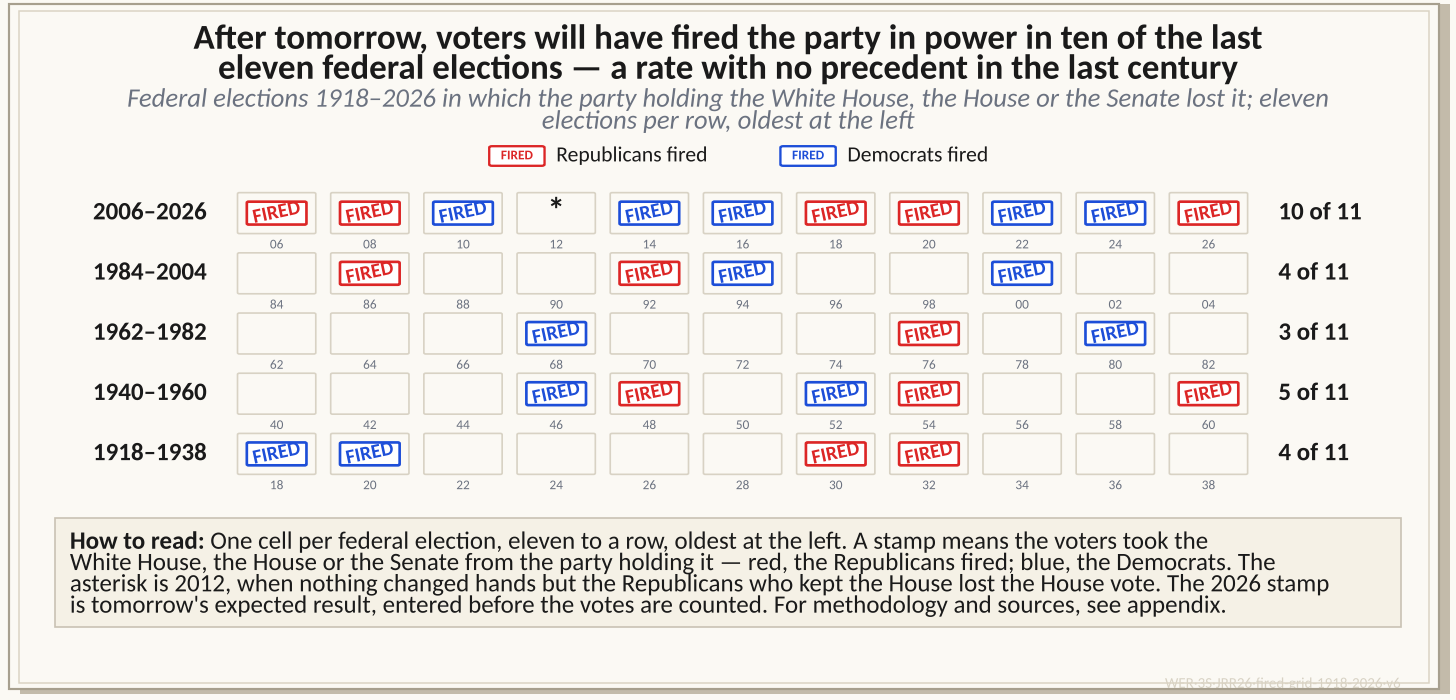
It’s a telltale sign of a broken political system and a public deeply dissatisfied with that system.
Yet instead of dropping out, disaffected Americans have been turning out at record rates — not because they think politicians will make their lives better, but because so many believe that politicians (especially Trump and MAGA Republicans) can make their lives much worse if they don’t. (I explained this at greater length in “Turns Out, Turnout Matters.” And as I explained in “How Trump ‘Won,’” a collapse in turnout and support from previous anti-MAGA surge voters was a key driver of Harris’s 2024 loss.)
The Senate: The Election of a Lifetime (Or More)
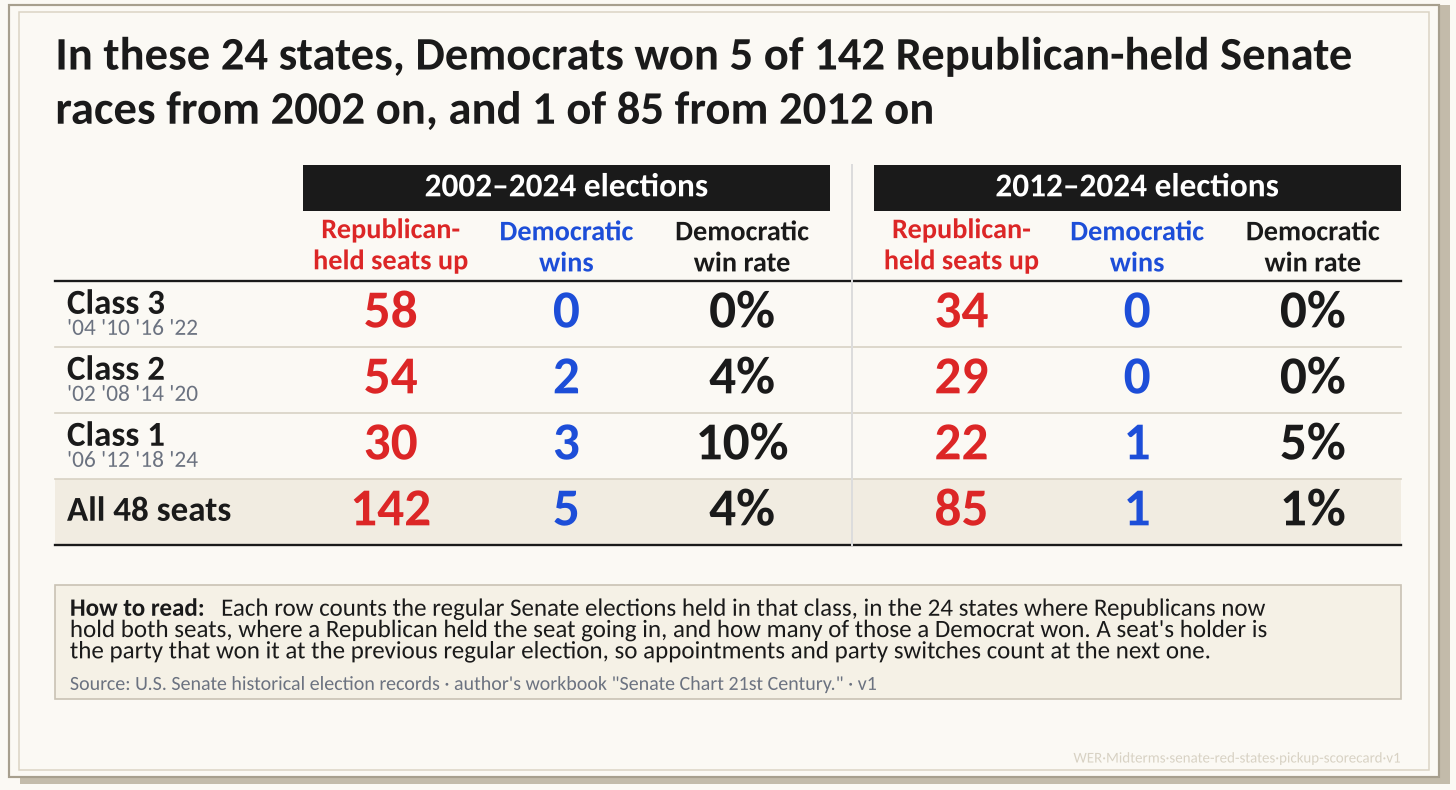
For the 21st century, Republicans have had an all-but-complete lock on 24 red states in the Senate. Some of those states haven’t seen a Senate seat flip in over a hundred years.
If Democrats flip Alaska, Iowa, Kansas, Ohio and Texas — five seats — then they will have flipped as many seats in those 24 red states this election as they have in the 142 elections those states have had since 2002. (To be clear, it’s not a “bad map” for Democrats this year — it’s a bad map every year, because the Senate is an ongoing violation of Americans’ rights to equal representation. Republicans hold 53% of Senate seats, yet those seats represent just 47% of the population; Democrats would have to represent over 60% of the population just to get to 51 seats.)
Here’s the scoreboard in those 24 states:
For the last two years, the moderation industrial complex has been parroting Republican talking points exhorting Democrats that the only way to win red-state Senate seats is to take more conservative positions on specific issues.
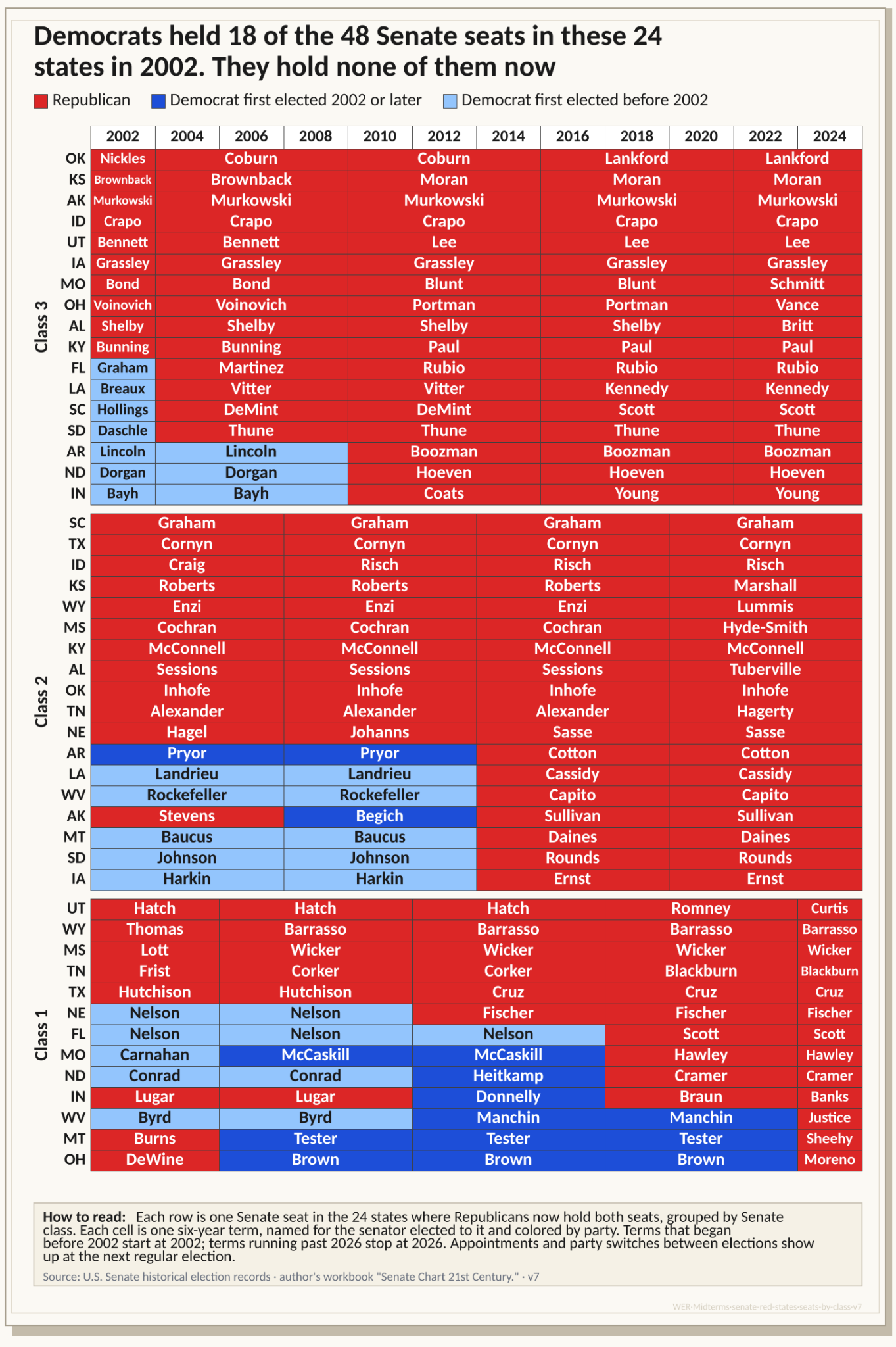
But as the next visualization shows, it’s much more important when Democrats run for Senate in those states than what they run on.
The Senate has three “classes” that come up for re-election at different times. Many of the 58 Democrats running in Class 3 (top row) were moderates and some were conservatives — but they all lost. Meanwhile, Class 1 (bottom row) had the good fortune of coming up for re-election in 2006 and 2012, both Democratic wave years. In the 21st century, almost the only Democrats who have won Senate seats in red states were either pre-existing incumbents (light blue) or rode a wave year (2006, 2008, 2012).
Enthusiasm!
It’s always a challenge to extrapolate from early vote data. But, it’s still worth looking at early vote enthusiasm when apples to apples comparisons are possible. We’re seeing a big enthusiasm gap in Democrats’ favor, but we’ll also need to see significant Republican defections to flip those battleground Senate seats.
This chart looks at the rates of early voting this year in the Senate battlegrounds among those who also voted early in 2024 ,comparing voters modeled by Catalist as likely Democrats to those modeled as likely Republicans.1 As you can see, it’s blue across the board, with some of the biggest advantages in areas that are considered base territory for Republicans. That’s driven much more by depressed turnout among likely Republican voters than because of higher turnout among likely Democrats.
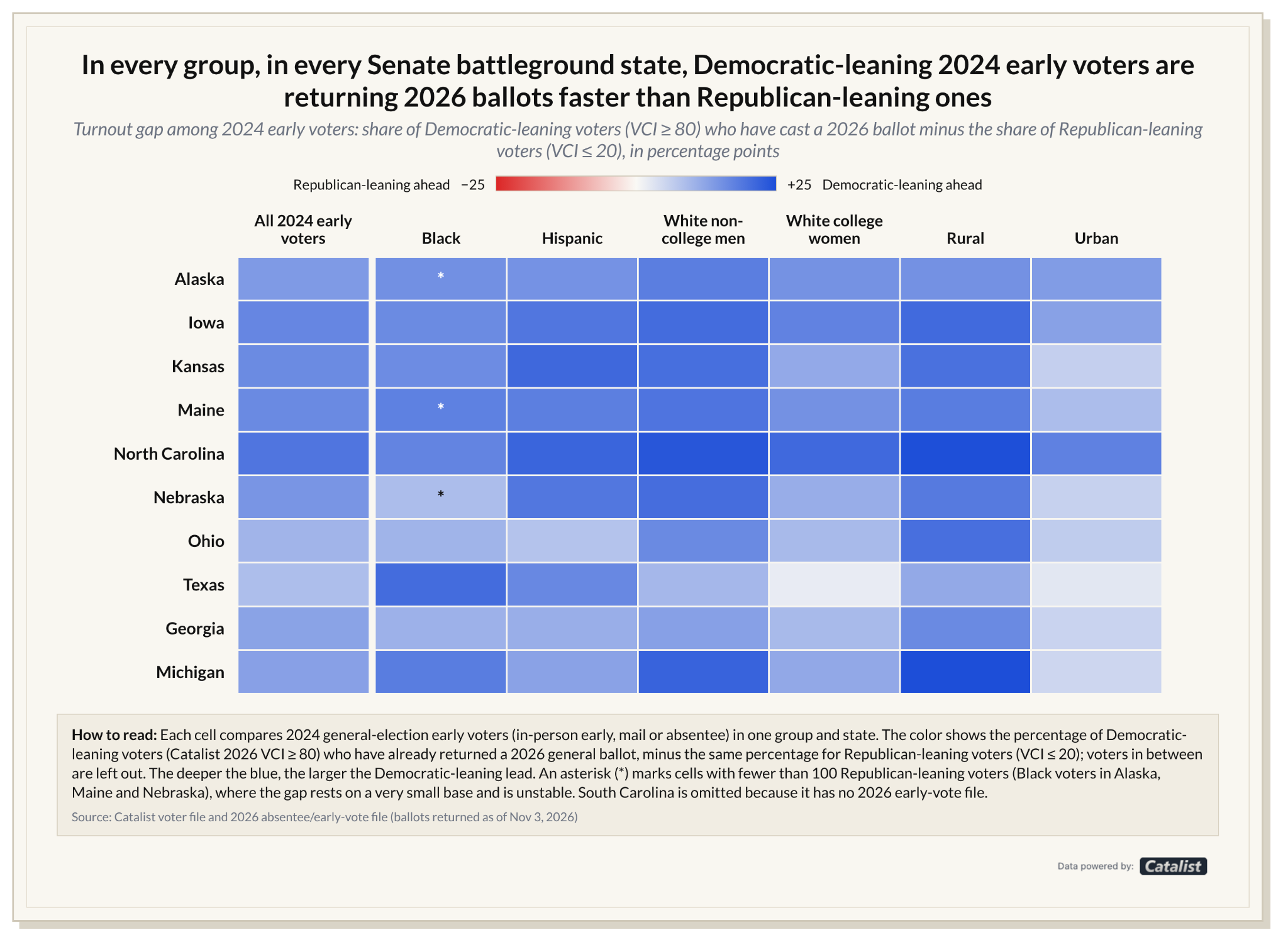
If you’ve been following reports about early voting, some of those cells might not seem blue enough. That’s because Democratic voters have been hearing a lot about Trump’s attempts to suppress the vote, especially mail ballots, and they’ve been mobilized to vote early by efforts such as No Kings. As a result, a significant number of Election Day voters have voted early, something we haven’t seen since 2020 (when many voted early by mail because of COVID.)
Here’s a map that shows how much more Democratic those who voted on Election Day 2024 and have voted already are than those Republicans who did the same.
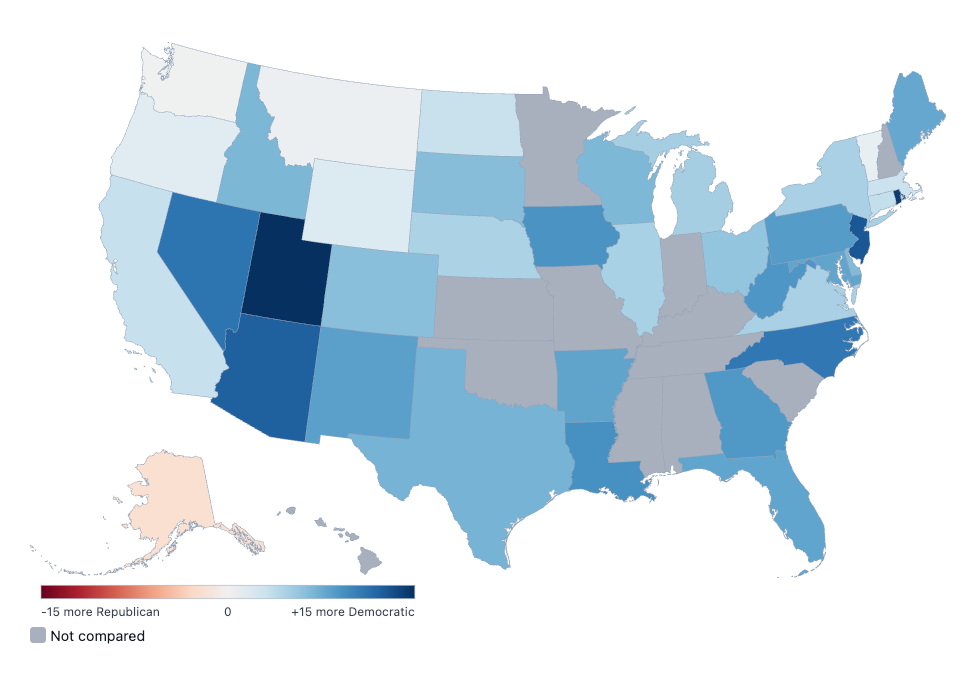
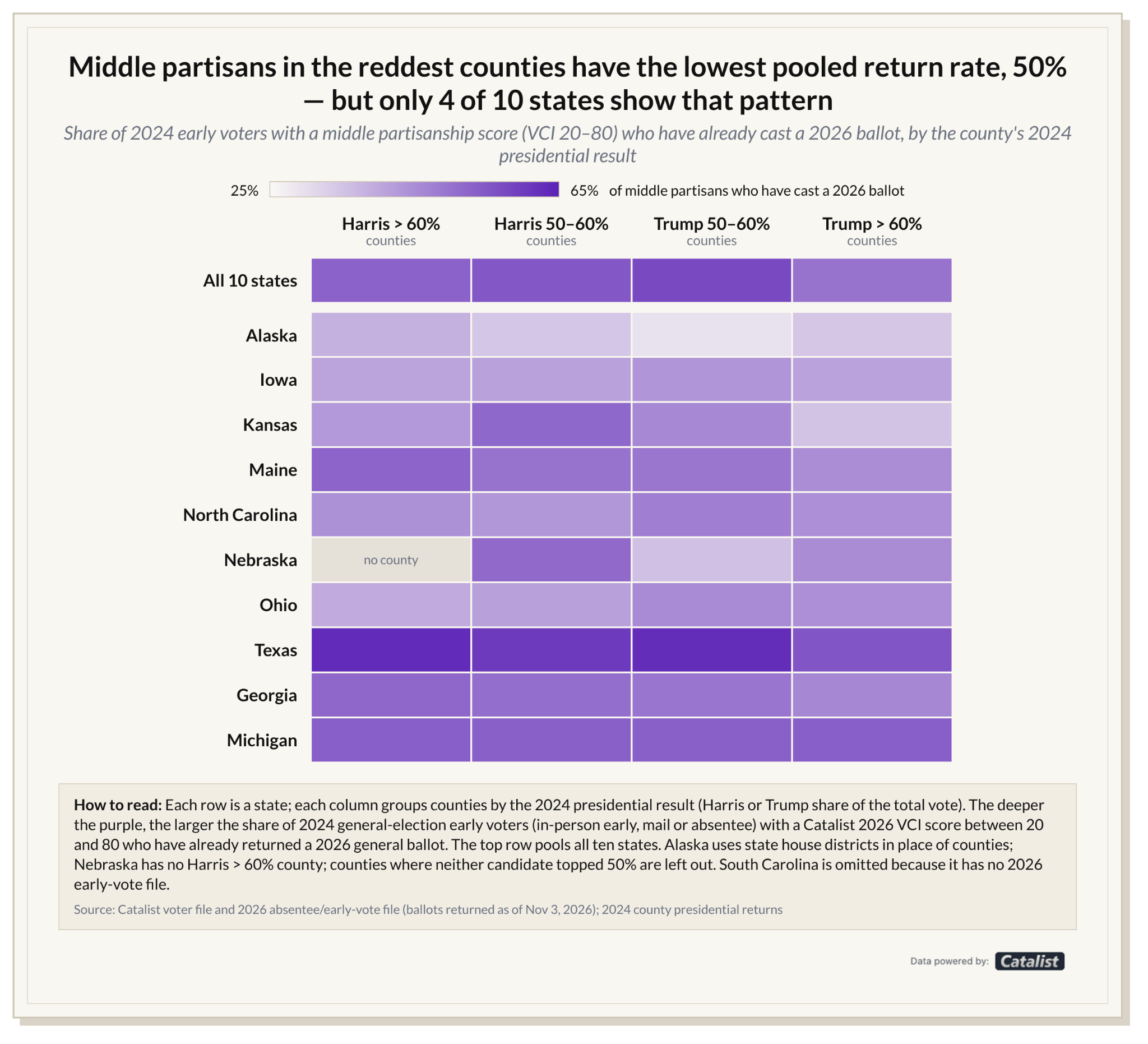
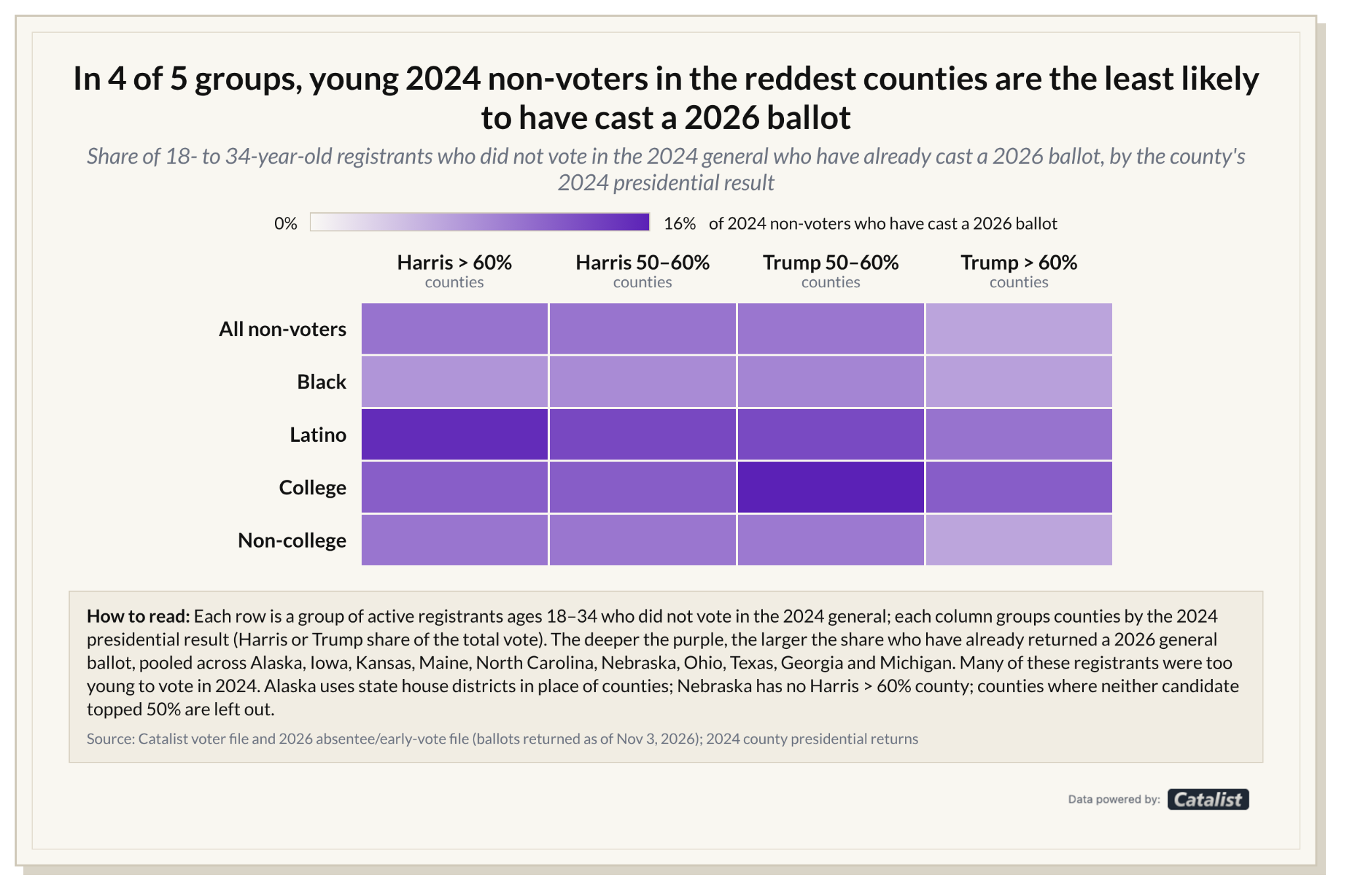
Now, let’s look at two sets of important voters: those who can’t be scored as likely partisans, and those who were too young to vote in 2024. The next two visualizations divide eleven states into four categories based on how well Harris did in 2024.
This chart looks at so-called middle partisans: the group of 2024 Republican voters most likely to switch to Democrats this year. I cannot underscore enough that the only way Republicans can lose those Senate battleground seats is if at least 15 percent of these middle partisans switch to Democrats this year. With a bit more than half of this year’s voters being regular midterm voters (which in most states is a 40-60 D-R group, the only way to make up that much ground is with both a huge partisan turnout differential and with an unprecedented number of defections.
Since it’s very difficult to score those who haven’t voted, the next chart looks at early voting rates among voters 18-34 who didn’t vote in 2024, by the partisan breakdown of the counties they voted in. Most striking? How much lower the turnout is from young first-time or infrequent voters in counties Trump won by 60 percent or more.
The John Roberts Midterms: The Confederate Realignment Continues Apace
Asking whether something will “go wrong” in this election moves the goalposts, because the Roberts Court has been interfering in our elections for the last 20 years.
Here are some key charts from “The Confederate Realignment” on how the Roberts Rules will affect the results this year.
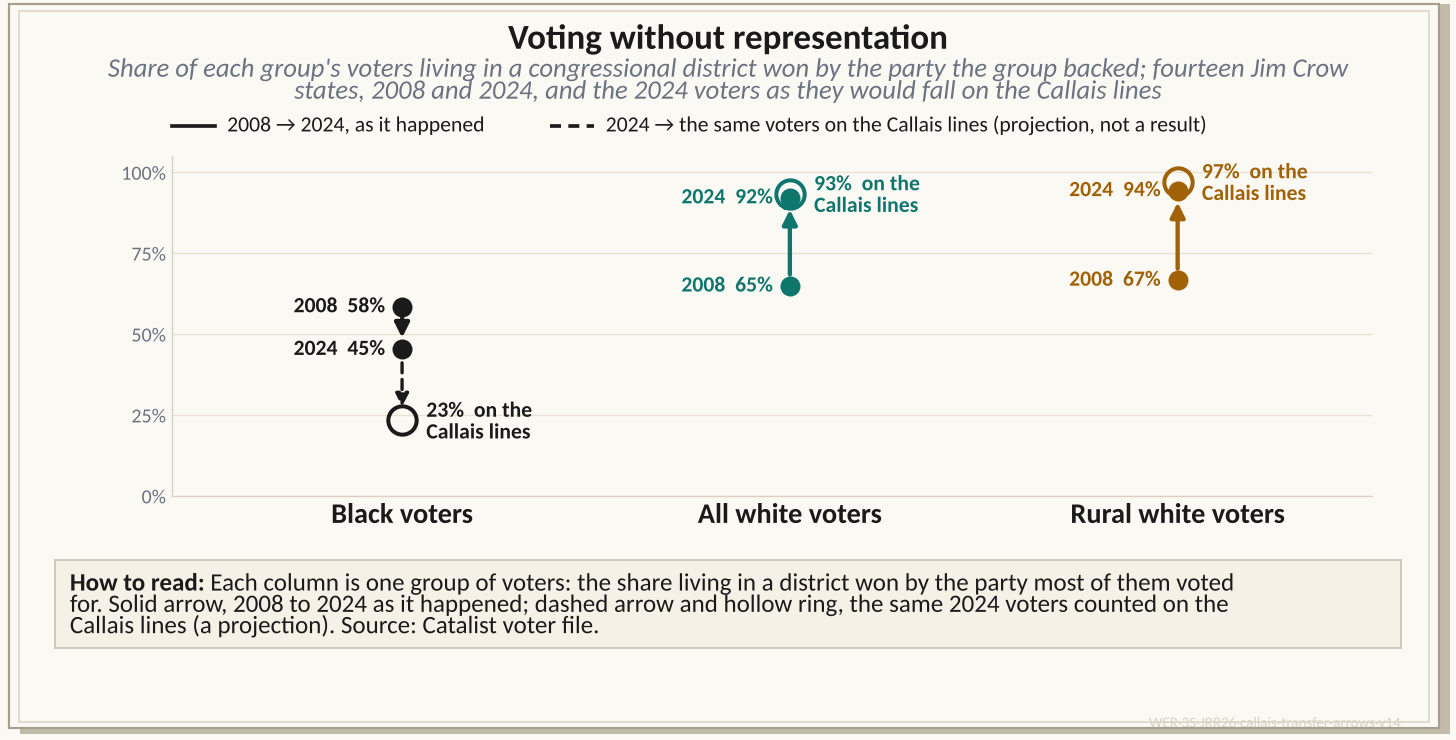
Voting without Representation
For most of the country’s history, Black Americans have had their votes stolen in one way or another. I say “stolen” because the votes in state legislatures and in Congress they were cast by those who had first enslaved and then disenfranchised them, constituting a “white power bonus” for the white supremacist ruling interests who gained disproportionate power over all Americans as a result.
First, of course, the white power bonus came from counting enslaved Black people as three-fifths of a person for congressional and Electoral College representation. During the Jim Crow era, Black Americans were counted as full persons while still mostly being prevented from voting.
For a few decades, the Voting Rights Act curbed the white power bonus. The Roberts Rules have brought it back, allowing Black people to vote while denying them an equal chance to vote for the eventual winner. I call this “voting without representation.”
In 2008, white and Black voters in the Jim Crow states were about equally likely to live in a district that elected the candidate their group favored (65 percent of white voters and 58 percent of Black voters). By 2024, 92 percent of all white voters and 94 percent of rural white voters did, compared to just 45 percent of Black voters. If the 2024 election had been held on the lines Callais now allows, 97 percent of rural white voters would be represented by their group’s chosen candidate — and just 23 percent of Black voters.
The Billionaire (Tech) Boys Club
Citizens United and related cases realigned the Republican Party’s funding base — and with it the balance of power both within the party and within the Greater Confederacy, the 27 states with entrenched one-party control by MAGA Republicans.2
Before Citizens United, the money in the Republican Party came mostly from traditional Chamber of Commerce business interests — and business, whatever its partisan preferences, hedges. But after Citizens United, revanchist billionaires could claim the upper hand within the Republican Party over the more traditional corporate Republicans. Corporate and trade-association PACs mostly give to both parties, even when they favor one, and they still face contribution limits — $10,000 per candidate per election cycle. But nearly every major super PAC, and the largest donors to super PACs, use their unlimited funds entirely to benefit one party or the other.
This cycle, conservative outside groups had already spent more than $2 billion by the end of October, Elon Musk alone having put in $445 million; by midyear, Republican candidates for Congress had received a combined $208 million from every PAC in America — corporate, trade association, labor and leadership PACs together.
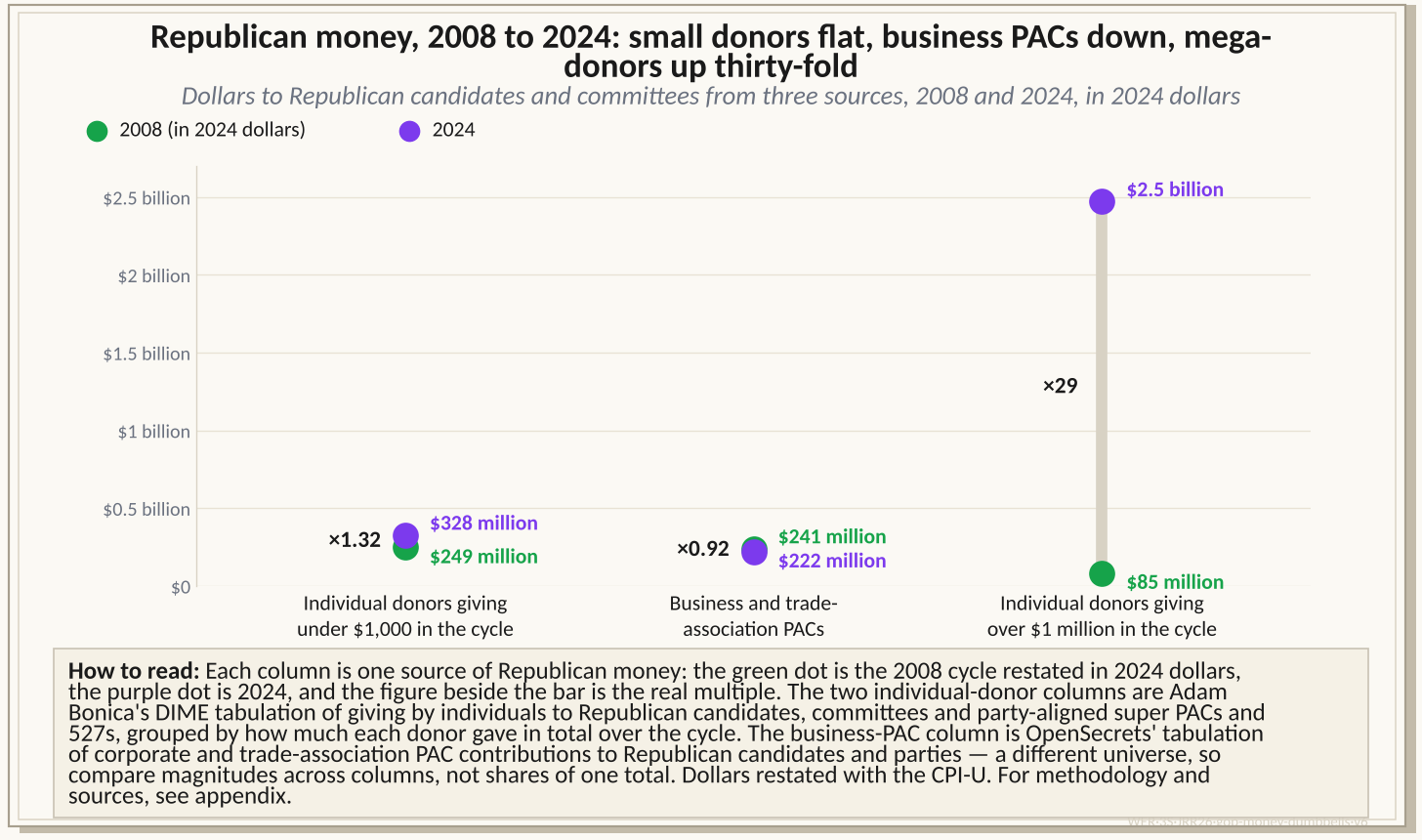
Remember, Musk and the other billionaires polluting our politics aren’t breaking the norms that prevailed before Roberts; they are breaking the laws that were in force before Roberts. Before the Roberts Rules, Elon Musk would have been limited to contributing $7,000 to any one candidate just as you and I are, compared to the nearly half a billion dollars he has already spent.
Even More MAGA Next Year than This Year
Because of the gerrymandering wars unleashed by the Roberts Rules, most of the seats Republicans lose this year will be their “least MAGA” members who represent districts in Blue states (slate arrow), while they will gain even more seats inside the Greater Confederacy (green arrow). And as a point of comparison, the Jim Crow share of the Democratic caucus before the New Deal was 68 percent; the Greater Confederacy’s share of the Republican caucus today is 71%. Jim Crow Democrats then, Greater Confederacy Republicans now.
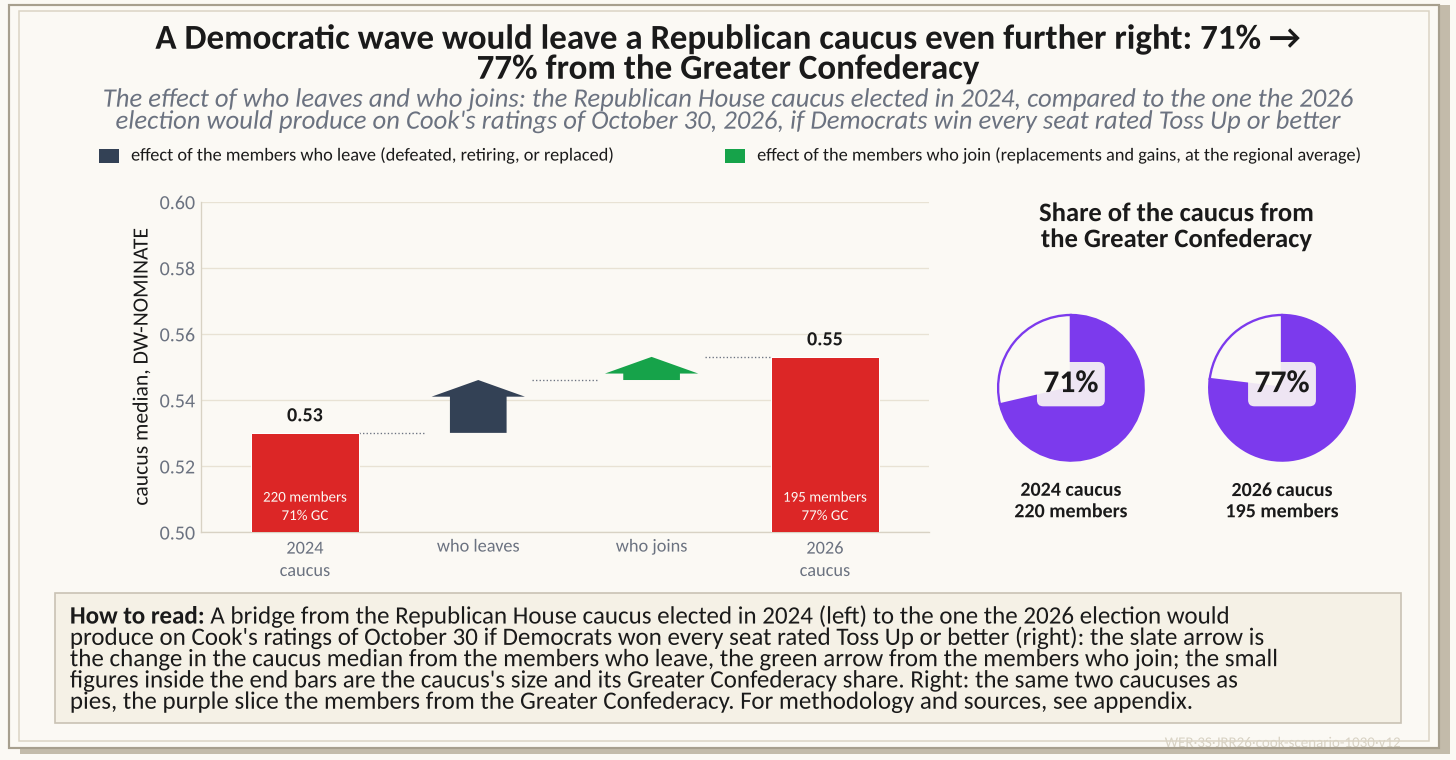
Remember: before John Roberts was confirmed in 2005, nearly every instrument the churches and billionaires have since used to rebuild the Greater Confederacy was either illegal or subject to federal review.3 Yet, at Roberts’ confirmation hearing, he insisted under oath that he would respect stare decisis and do no more than “call balls and strikes.” Four years later, he candidly told a C-SPAN audience that, as an unelected official, if the public disagrees with him it’s “more or less just too bad.”
No matter how bad the midterms may be for Republicans, it won’t touch the Roberts Rules, or those who gain from them, unless and until Democrats aggressively use their power to dismantle them. And even then, the regime that the Roberts Rules rebuilt won’t collapse on its own.
So, the real test of the midterms isn’t how many seats will change hands. It’s what Democrats will do with that power before the next election, and what the rest of us will do to make sure it happens.
In Praise and Memorium
However much we can and should celebrate our work to mobilize voters this year to reject the Trump regime, we mustn’t look pass those who did not do enough in 2024 to make plain to voters that putting Trump back into the White House would lead to exactly the hell we’ve all endured for the last two years. This goes double for the ones who ridiculed those of us warning about this outcome as having Trump derangement syndrome.
Also bearing responsibility are the media polling operations, most notably the New York Times, which can be both indispensable and indefensible. On the one hand, the Times did the full expose of what was to come with deportations in November 2023; on the other hand, Times pollsters asked abstract questions like “who’s better on immigration” instead of, say, whether voters supported Trump’s plans to build concentration camps for immigrants who have committed no crime. Those questions, and the horse race built on their answers, did as much as anything to persuade the country that what was coming was normal. (“Poll-Washing Our Way to Fascism”).
And we must reckon with the difficult truth that none of this was inevitable. The Roberts Rules and the Confederate Realignment, without which Trump could not have gotten back to the White House, happened in plain sight over decades. Yet the people and institutions that could have intervened to help stop it, from the press to the legal establishment to the Democratic Party, not only failed to do so; they have never been held accountable for that failure — and they are giving little sign that they won’t make the same mistakes again.
And we mustn’t forget the heroes, especially in Minnesota, who did not take the advice of the savvy doyens like Matt Yglesias and Chris Cillizza to avoid increasing the “salience” of an issue that Trump was thought to be “good” on.
The test of civil society is what it does between elections. The idea that the best way to stop fascism is to run good campaigns every two years on poll tested issues so Democrats can win is obscene.
I’d like to conclude this post by remembering our neighbors who are not here to celebrate with us now, thanks to the monsters of the Trump regime as well as the enablers who were complicit in that regime returning, and to the Roberts Court that prevented Trump from seeing trial for his crimes on January 6th and emboldened him with immunity.
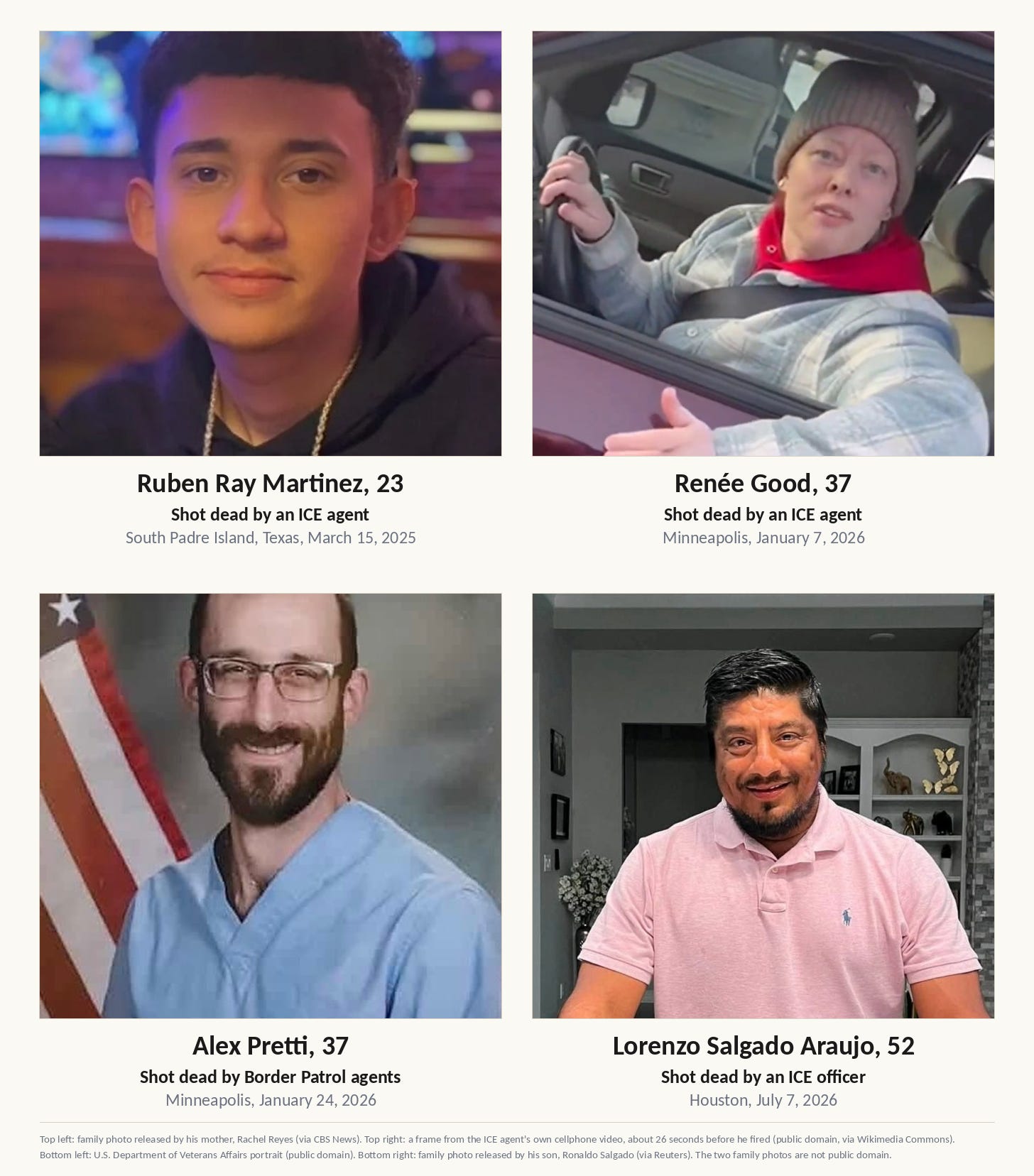
Of the nearly one million people who have been removed from the country since Trump took office, many of whom were abducted, four in five had no criminal conviction of any kind, and only about one in twenty of those detained by ICE had a conviction for a violent offense. More than 46,000 of the roughly 66,000 people in ICE custody this summer had never been convicted of anything. Some 55 to 60 people have died in ICE custody since January 20, 2025 — 2025 was the deadliest year in the system since 2004 — and many have been shot dead by immigration agents, including three American citizens (Renee Good, Alex Pretti, and Ruben Ray Martinez).
Most of the names of ICE’s victims are not well-known, or known at all. The list of deaths below is drawn from the running public record of deaths in ICE detention and of shootings by immigration agents.
2025: Genry Ruiz Guillen (Honduras, 29, Krome, Jan 23); Serawit Gezahegn Dejene (Ethiopia, 45, Eloy, Jan 29); Maksym Chernyak (Ukraine, 45, Krome, Feb 20); Juan Alexis Tineo-Martinez (Dominican Republic, 44, San Juan, Feb 23); Brayan Rayo-Garzon (Colombia, 27, Phelps County Jail, Mo., Apr 8); Nhon Ngoc Nguyen (Vietnam, 55, El Paso, Apr 16); Marie Ange Blaise (Haiti, 44, Broward, Apr 25); Abelardo Avelleneda-Delgado (Mexico, 68, Lowndes County, Ga., May 5); Jesus Molina-Veya (Mexico, 45, Americus, Ga., Jun 7); Johnny Noviello (Canada, 49, FDC Miami, Jun 23); Isidro Perez (Cuba, 75, Krome, Jun 26); Tien Xuan Phan (Vietnam, 55, Karnes, Tex., Jul 19); Chaofeng Ge (China, 32, Moshannon Valley, Pa., Aug 5, suicide); Lorenzo Antonio Batrez Vargas (Mexico, 32, Florence, Ariz., Aug 31); Oscar Duarte Rascon (Mexico, 58, Eloy, Sep 8); Santos Reyes-Banegas (Honduras, 42, Nassau County, N.Y., Sep 18); Ismael Ayala Uribe (Mexico, 39, Adelanto, Sep 22); Norlan Guzmán-Fuentes (El Salvador, 37) and Miguel Ángel García-Hernández (Mexico, 31), both shot by the sniper at the Dallas ICE facility, Sep 24; Huabing Xie (China, 53, Calexico, Sep 29); Leo Cruz-Silva (Mexico, 34, Ste. Genevieve County Jail, Mo., Oct 4, reported suicide); Hasan Ali Moh’D Saleh (Jordan, 67, Krome, Oct 11); Gabriel Garcia-Aviles (Mexico, 56, Adelanto, Oct 23); Kai Yin Wong (China, 63, South Texas, Oct 25); Francisco Gaspar-Andres (Guatemala, 48, Camp East Montana, El Paso, Dec 3); Pete Sumalo Montejo (Philippines, 72, Montgomery, Tex., Dec 5); Shiraz Fatehali Sachwani (Pakistan, 48, Prairieland, Tex., Dec 6); Jean Wilson Brutus (Haiti, 41, Delaney Hall, Newark, Dec 12); Delvin Francisco Rodriguez (Nicaragua, 39, Natchez, Miss., Dec 14); Fouad Saeed Abdulkadir (Eritrea, 46, Moshannon Valley, Dec 14); Nenko Stanev Gantchev (Bulgaria, 56, North Lake, Mich., Dec 15).
2026: Geraldo Lunas Campos (Cuba, 55, Camp East Montana, Jan 3 — autopsy ruled homicide by asphyxia); Luis Gustavo Nunez Caceres (Honduras, 42, Conroe, Tex., Jan 5); Luis Beltran Yanez-Cruz (Honduras, 68, Calexico, Jan 6); Parady La (Cambodia, 46, Philadelphia, Jan 9); Victor Manuel Diaz (Nicaragua, 36, Camp East Montana, Jan 14, “presumed suicide,” disputed by family); Heber Sanchez Dominguez (Mexico, 34, Lovejoy, Ga., Jan 14); Jairo Garcia-Hernandez (Guatemala, 27, Miami, Feb 16); Lorth Sim (Cambodia, 59, Bunker Hill, Ind., Feb 16); Alberto Gutierrez-Reyes (Mexico, 48, Victorville, Calif., Feb 27); Pejman Karshenas Najafabadi (Iran, 59, Natchez, Mar 1); Emmanuel Clifford Damas (Haiti, 56, Florence, Ariz., Mar 2, tooth infection); Mohammad Nazeer Paktyawal (Afghanistan, 41, Dallas, Mar 13); Royer Perez-Jimenez (Mexico, 19, Glades County, Fla., Mar 16); Jose Guadalupe Ramos-Solano (Mexico, 52, Adelanto, Mar 25); Tuan Van Bui (Vietnam, 55, Bunker Hill, Apr 1); Alejandro Cabrera Clemente (Mexico, 49, Winn, La., Apr 11); Aled Damien Carbonell-Betancourt (Cuba, 27, FDC Miami, Apr 12); Denny Adan Gonzalez (Cuba, 33, Lumpkin, Ga., Apr 28); Mamuka Artmeladze (Georgia, 43, Winn, Jun 4); Felix Alcorta-Rodriguez (Mexico, 63, Laredo, Jun 19); Jesus Manuel Arenas-Silva (Venezuela, 45, in transit in Georgia, Jul 13); Prisciliano Trejo Ricano (Mexico, 29, Augusta, Ga., Jul 24); Edwin Lopez-Cornejo (El Salvador, 41, Delaney Hall, Aug 1); Lian Yong Wei (China, 51, Saipan, Aug 23).
Sources: List of deaths in ICE detention, icetracking.org
Weekend Reading is edited by Emily Crockett, with research assistance by Andrea Evans.
Most states include voting through the weekend. Catalist has a 1 to 100 partisanship scale. Those with scores below 20 are treated as likely Republicans and those with scores above 80 are treated as likely Democrats. Those with scores between 20 and 80 are considered “middle partisans.”
Consists of 27 states: 14 of the Jim Crow states (Alabama, Arkansas, Florida, Georgia, Kentucky, Louisiana, Mississippi, Missouri, North Carolina, Oklahoma, South Carolina, Tennessee, Texas and West Virginia) as well as Alaska, Arizona, Iowa, Idaho, Indiana, Kansas, Montana, North Dakota, Nebraska, Ohio, South Dakota, Utah and Wyoming.
Crucially, the standard for inclusion is not how each state’s citizens vote, but that the organized interests have a durable lock on the state legislature and have entrenched a legal regime that defends itself from electoral accountability and perpetuates its power. Membership is therefore time-dependent: a state joins when its regime is captured and leaves if it no longer is.
By “MAGA coalition,” I don’t mean ordinary Trump voters. I mean the longstanding alliance of billionaires who never made peace with the New Deal, and religious-right leaders who never made peace with the 20th century’s successful challenges to America’s racial and gender caste systems. This coalition powered Trump’s rise, but it long predates him and will outlast him. It carries forward the same white Christian nationalist, authoritarian project as its predecessors: the enslavers, the “Redeemers” who overthrew Reconstruction, and the architects of Jim Crow.
Roberts was confirmed September 29, 2005. Under the law on that date, corporate and union treasury spending on independent expenditures in elections was barred, plus soft money expenditures by for-profit and non-profit corporations that tried to go around campaign funding limits were also restricted (Abood, 1977; Austin, 1990; McConnell, 2003); every change to voting rules in the VRA covered jurisdictions required federal preclearance; partisan gerrymanders could still be challenged in federal court (Bandemer, 1986; Vieth, 2004); and Section 2 allowed courts to consider the effects of map and voting changes, such as vote dilution under the Gingles precedent (1986). The Roberts Court undid each: Citizens United (2010), Shelby County (2013), Rucho (2019), Brnovich (2021), Callais (2026), and more.
I wrote about how unthinkable this would seem to a time-traveler from 2009 in ”Change No One Would Have Believed.”
Thank you, Mr. Podhoretz. ❤️🙏 for all the innocent lives lost.
Let us also remember our transgender family - who have been cruelly, viciously and intentionally targeted - with millions of right-wing media dollars to paint them as a threat.