
Note: Much of what follows is drawn from a larger book-length project I’ve been working on. Today, I’ll offer the core arguments that matter most right now, on the eve of the midterms and at the start of the Roberts Court’s new term.
For the sake of readability, I’ve put the sources and methodology behind the visualizations in an appendix at the end of the post, and supporting detail for the arguments and narrative in footnotes. Where I’ve developed an argument at greater length in earlier Weekend Readings, I link to those pieces.
Special thanks to Weekend Reading editor, Emily Crockett, and research assistant Andrea Evans, for all of their work on this project.
This week, Republicans will almost certainly suffer big midterm losses, perhaps even losing the Senate as well as the House. It will be an obvious rebuke of Trump and MAGA by the voters — which shouldn’t surprise us, because, as I’ve written, the nation has a strong anti-MAGA majority that never actually went away.
Despite this, we can be confident that MAGA will emerge with even greater control of the Republican Party after the midterms. If you still hope that this time Republicans losing elections will “break the fever,” you will be disappointed again.
The reason for this is the same reason America is in crisis today: the MAGA coalition has managed to rebuild, across roughly half the country, the types of one-party regimes that defined the Jim Crow South.
To get out of this crisis, we must start by recognizing that this didn’t happen naturally and was the result of a deliberate political project. We must understand that project as the source of the problem and commit to the long, hard work of dismantling what it built — just as previous generations did in the fights to end enslavement and advance civil rights.
And we must reckon with the difficult truth that none of this was inevitable. It happened in plain sight over decades. Yet the people and institutions that could have intervened to help stop it, from the press to the legal establishment to the Democratic Party, not only failed to do so; they have never been held accountable for that failure — and they are giving little sign that they won’t make the same mistakes again.
By “MAGA coalition,” I don’t mean ordinary Trump voters. I mean the longstanding alliance of billionaires who never made peace with the New Deal, and religious-right leaders who never made peace with the 20th century’s successful challenges to America’s racial and gender caste systems.1 This coalition powered Trump’s rise, but it long predates him and will outlast him. It carries forward the same white Christian nationalist, authoritarian project as its predecessors: the enslavers, the “Redeemers” who overthrew Reconstruction, and the architects of Jim Crow.
That MAGA coalition fell short of its ambitions for decades until it stacked the Supreme Court with its own justices. Those justices delivered the tools the coalition needed to gain more power without gaining more voters. With those tools, the coalition took over the Republican Party in Congress and in roughly half the state legislatures, shielding both itself and the justices from any semblance of democratic accountability. I call those tools the Roberts Rules2, and their transformation of our politics, the Confederate Realignment.
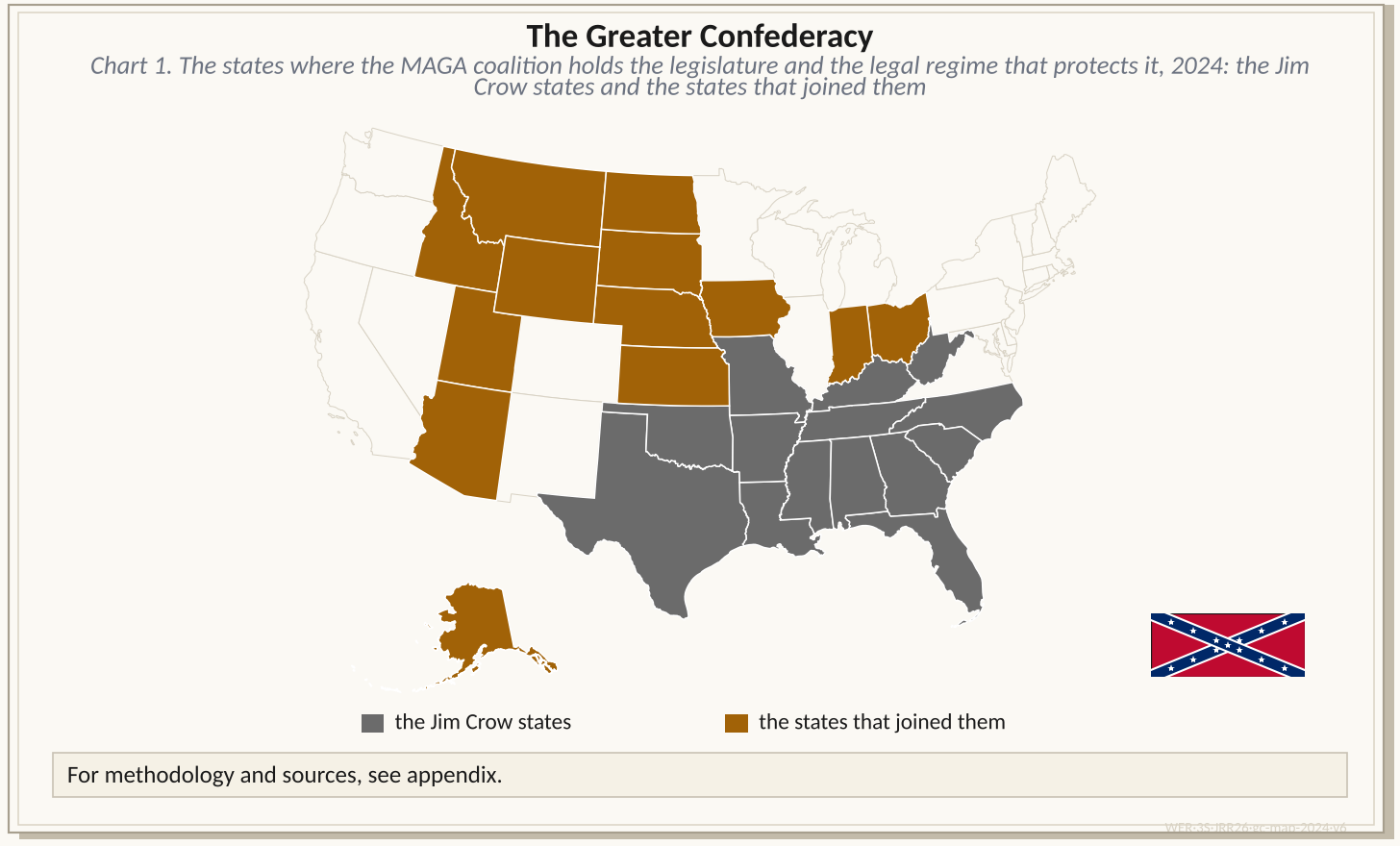
The billionaires supply the money, and the churches supply resources of their own3, along with something money alone can’t buy: a geographic power base, where white evangelicals make up about half or more of Republican primary voters (more below). That base is what I call the Greater Confederacy: 27 states, anchored by the original Confederate and Jim Crow states, where the MAGA coalition’s interests have little to fear from voters.4
And unlike the rulers of the Jim Crow South, who were only able to defend their “way of life,” today’s MAGA coalition is imposing its “way of life” on all of us, in what I have called a War of Southern Aggression.
The last time a Southern ruling class came close to achieving that, its agents on the Supreme Court handed down Dred Scott — going far beyond what the case required in order to put enslavement beyond the reach of Congress. The Roberts Court has made the same kind of move its signature. Again and again, it not only reached past the question in front of it to hand the MAGA coalition more power — it also, like the Taney Court, insisted that the Constitution itself commanded the result.5 (A statutory ruling can be overridden by the next Congress; a constitutional one can be undone only by the Court itself or by amendment, where no simple majority can reach it.)
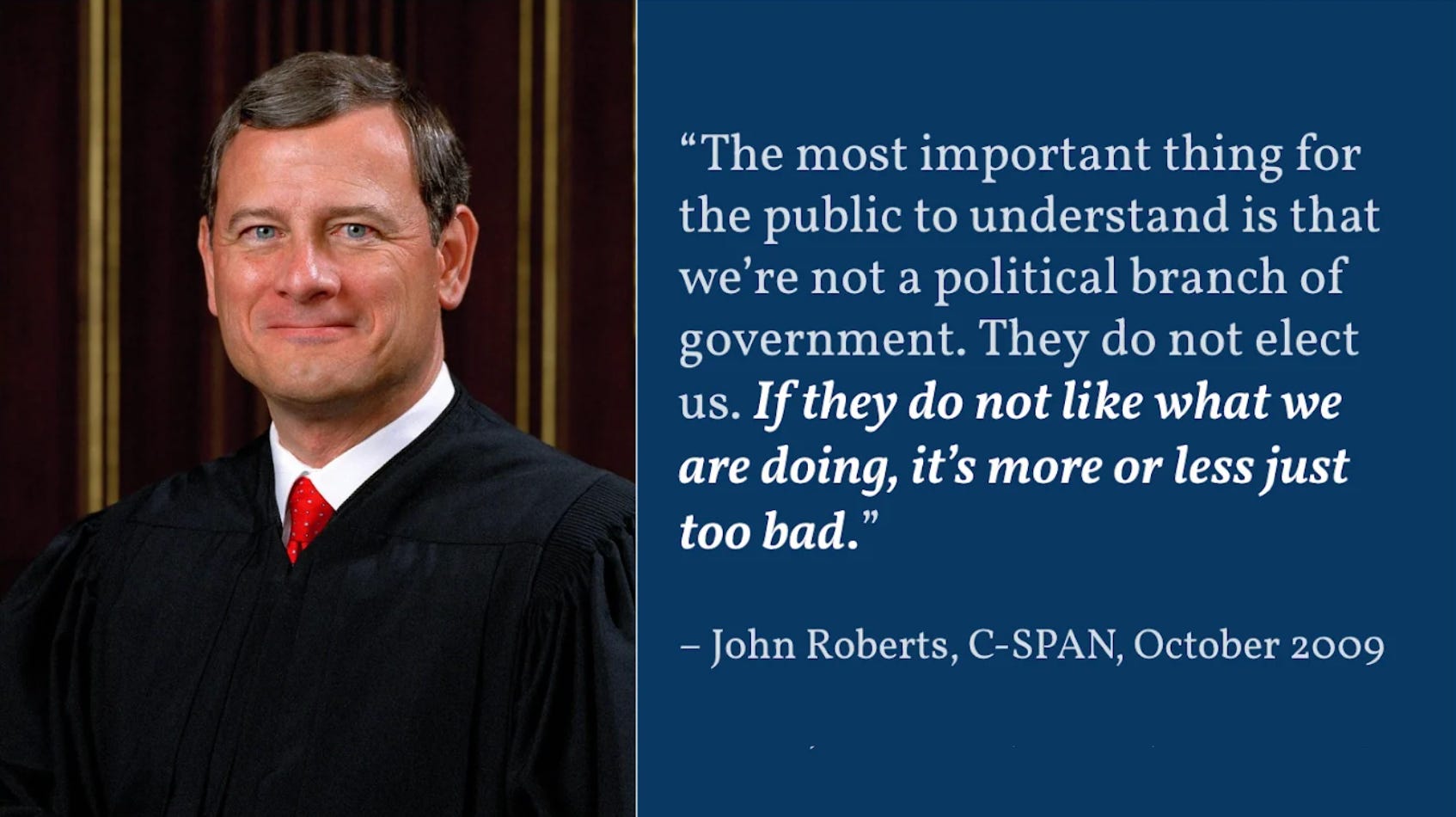
Remember: before John Roberts was confirmed in 2005, nearly every instrument the churches and billionaires have since used to rebuild the Greater Confederacy was either illegal or subject to federal review.6 Yet, at Roberts’ confirmation hearing, he insisted under oath that he would respect stare decisis and do no more than “call balls and strikes.” Four years later, he candidly told a C-SPAN audience that, as an unelected official, if the public disagrees with him it’s “more or less just too bad.”
No matter how bad the midterms may be for Republicans, it won’t touch the Roberts Rules, or those who gain from them, unless and until Democrats aggressively use their power to dismantle them. And even then, the regime that the Roberts Rules rebuilt won’t collapse on its own.
So, the real test of the midterms isn’t how many seats will change hands. It’s what Democrats will do with that power before the next election, and what the rest of us will do to make sure it happens.
“We” Are Not Divided; They Divided Us
We constantly hear about Americans being “divided,” and nobody needs to be told that people vote differently in blue and red states. That’s not what I am talking about. What we’re actually seeing is not divisions between ordinary Americans, but between the ruling interests of different regions of the country. This type of division, known as sectionalism, was properly understood for most of American history as a major, if not the, central source of political conflict, until we started calling it “polarization” and blaming it on voters realigning themselves by ideology or education.7
When we hear about political realignments, we hear about broad groups of voters (Latinos, working class, etc.) changing their partisan allegiances.8 That misdirection has caused us to miss America’s most consequential political realignment in more than a century — the Confederate Realignment — which, as I’ll explain below, was achieved in spite of, not because of, the will of most voters.
At its core, the Confederate Realignment is a return to entrenched one-party rule: not where one party happens to win most elections, but where the ruling party has made itself nearly impossible to vote out. It works in two ways.
First, once that party has locked down the state’s government, the state becomes a political company town. Everyone with money or ambition has to do business with the party in power. That includes the small and mid-sized businesses, lawyers, developers and other professionals who fund most state and local campaigns, and the people who might otherwise run for office. Backing the other party becomes a losing proposition, so the opposition withers.
Second, the ruling party uses its lock on power to draw the district lines, write the voting rules, and pick the judges that keep it that way. All of that together creates a perpetual power machine.
Blue states can look one-party too, but they’re not at all the same. In blue states, the rules haven’t been rewritten to keep Republicans out of power. Indeed, voting has become easier in blue states, as I’ll come back to later. Rather, the Republican Party has made itself largely unelectable there, thanks to the runaway radicalization that the Roberts Rules unleashed. (For more on why one-party rule in the Greater Confederacy is fundamentally different than in the rest of the country, see this footnote.9)
In fact, the typical “red vs. blue” frame leads us astray entirely, because it makes us think of Democrats and Republicans as two partisan “teams” playing the same game, whose differences reflect either the politicians themselves or the voters they appeal to. That story keeps our attention on the “players” and the “fans,” when we should be looking at the “owners”: the organized interests that have the greatest hand in deciding who the candidates will be, and what they do when they are elected. The owners, not the fans, are most likely to get what they want when their team wins.10 And most critically, some of the owners have now decided who the umpires — and the commissioner — will be.
Below, in section I, I’ll show what the Confederate Realignment looks like — the many ways in which one-party rule has returned in the Greater Confederacy over just the last two decades, and how Republicans are now at least as much the party of the Greater Confederacy as Democrats were the party of the Jim Crow South.
In section II, I’ll explain how the Roberts Rules licensed the MAGA coalition to set the perpetual power machine in motion. The result is a newer form of disenfranchisement that I call “voting without representation” — which affects all of us, not “just” the groups targeted for exclusion.
I. Jim Crow Democrats Then; Greater Confederacy Republicans Today
When the Roberts Court began gutting the Voting Rights Act, critics warned that it would bring back Jim Crow, which defenders of the Court dismissed as hyperbole. But the Roberts Rules have restored the functions of the Jim Crow political order more literally than even early critics realized.
I want to be precise about what I mean. Jim Crow was two systems. One was social control: the segregation statutes, the terror, the daily humiliations. The other was political: a set of rules that created the perpetual power machine and prevented challenges to the entrenched interests. The region’s rulers were protected from answering to most of their citizens, but they could still count those excluded citizens to inflate their own power in Congress and the Electoral College. That is the system the Roberts Rules rebuilt — not with poll taxes and literacy tests, but with tools that accomplish much the same thing.
The Greater Confederacy dominates the Republican caucus even more than the Jim Crow states dominated the Democrats’ before the New Deal.
In this and the following visualizations, colors denote the era: brown for Jim Crow; green for 2004, the last presidential election before Roberts; and purple for 2024, the era of Roberts Rules.
Let’s start with the simplest “if it walks like a duck…” test of whether a region has captured a party: how much of the party’s congressional delegation comes from that region, compared with how much of the party’s vote does. The chart below sets the Jim Crow Democrats of 1924 beside the Republicans of 2004 and 2024.
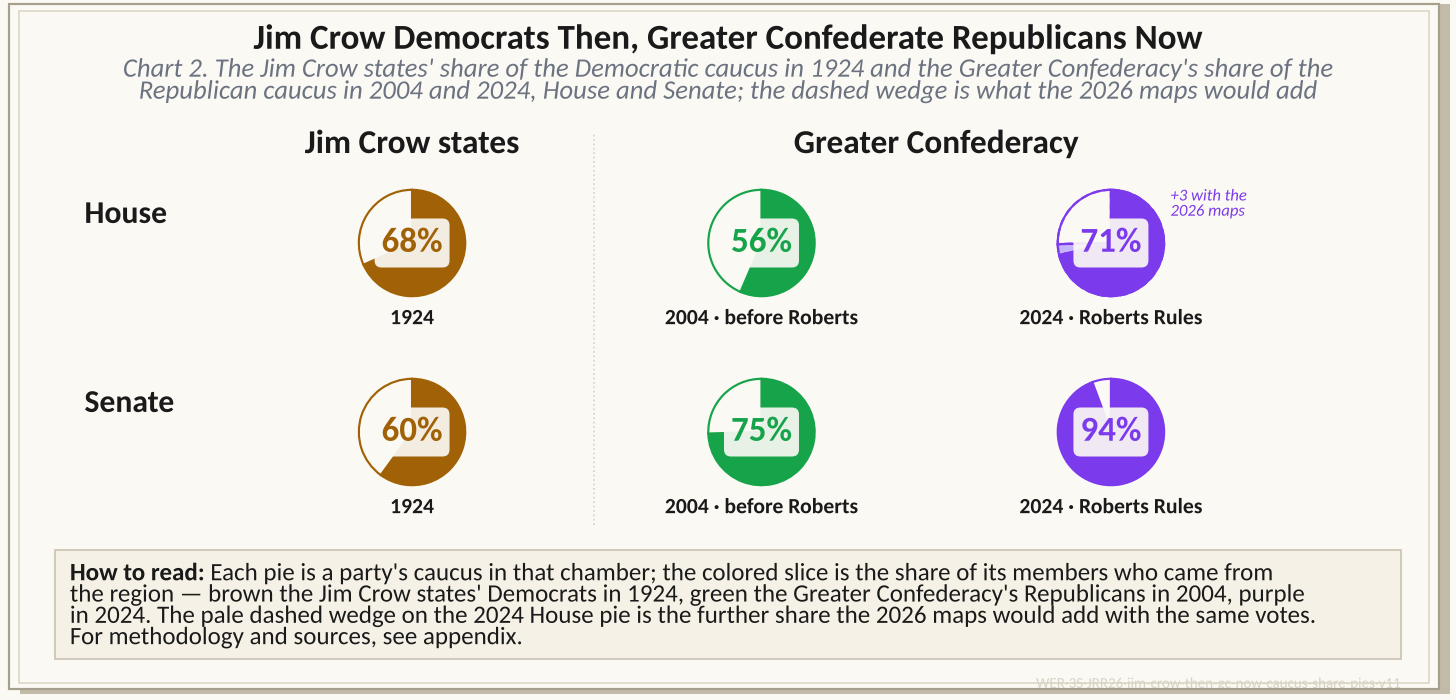
The House: In 2004, the Greater Confederacy held a share of the Republican House caucus roughly proportional to its share of the party’s votes: 56 percent of the caucus, on 51 percent of the votes for Republican House candidates nationwide. Today its share of the party’s voters has barely moved, to 55 percent — but its share of the caucus has jumped to 71 percent. It would have been nearly 75 percent if the 2024 election had been held on this year’s Callais lines.
That’s a greater share of its party’s caucus than the Jim Crow states held of the Democratic caucus in 1924, when they held 68 percent of the party’s House seats despite casting just 38 percent of the Democratic presidential vote.11
The Senate: The same basic thing happened, from a higher starting point, because the Constitution already gives small and rural states overrepresentation in the Senate. In 2004, Greater Confederacy senators were 75 percent of the Republican Senate caucus on 55 percent of the vote; today they are 94 percent of the caucus on just 53 percent of the vote.
As during Jim Crow, Confederate interests in Washington get “bonus” seats by stealing political power from Black voters.
Despite winning only about three points more of the vote in the Greater Confederacy in 2024 than they did before the Roberts Rules in 2004, Republicans hold ten points more of the region’s House seats — 35 more seats than their share of the vote would give them proportionately.12 It would have been 46 if the 2024 election had been held on the Callais lines in force for 2026. The Jim Crow Democrats of 1924 held 40 seats beyond proportion.
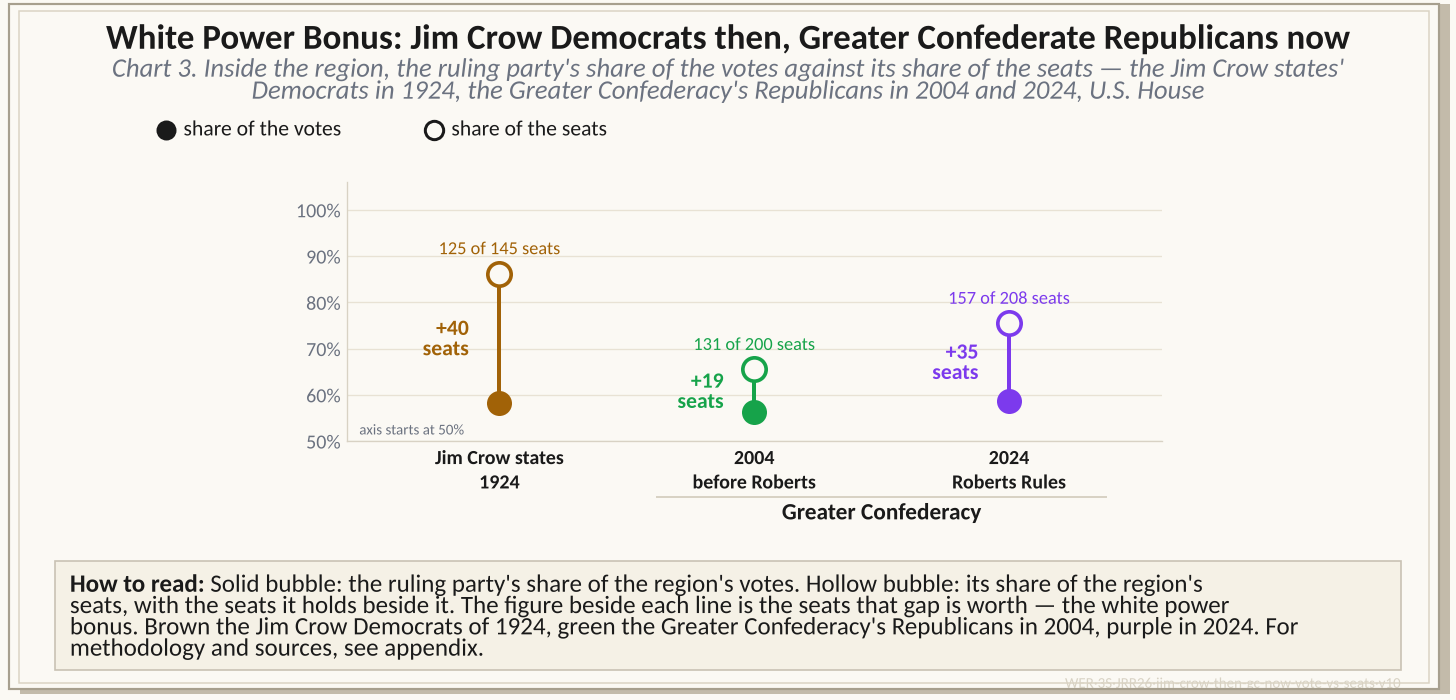
Call those extra seats what they are: a white power bonus for the Confederate interests (not for all white people, or even all white Southerners). Jim Crow got its bonus by counting Black citizens it wouldn’t allow to vote. The Greater Confederacy gets its bonus by counting Black citizens whose votes don’t count — in other words, voting without representation.
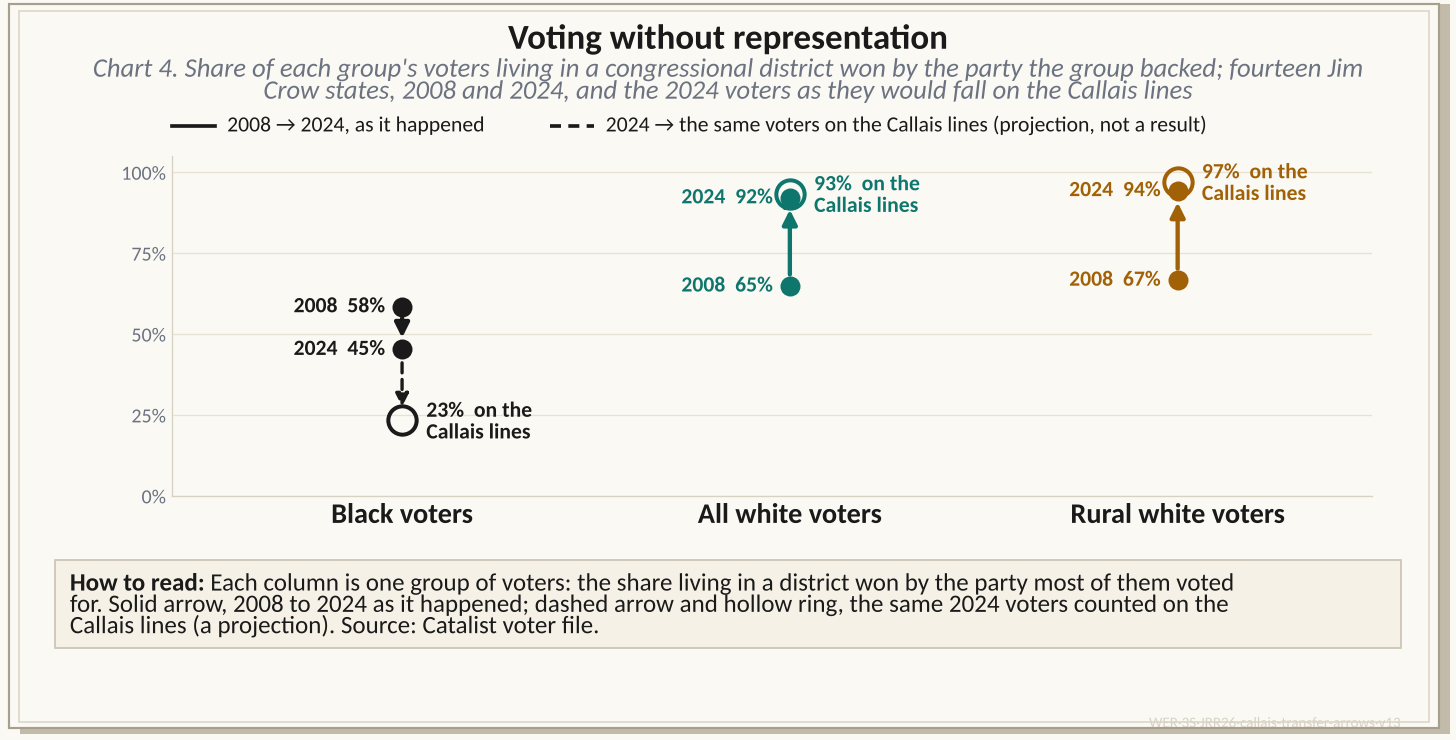
The Voting Rights Act was enacted to prevent mostly Southern Jim Crow legislatures from disenfranchising Black voters, as they had for nearly three-quarters of a century, and the 1982 reauthorization of the VRA was intended to prevent those states from using gerrymandering to dilute Black voting power. The Roberts Court effectively finished killing the VRA with Callais, and the results are already telling.
In 2008, white and Black voters in the Jim Crow states were about equally likely to live in a district that elected the candidate they favored (65 percent of white voters and 58 percent of Black voters). By 2024, 92 percent of all white voters and 94 percent of rural white voters did, compared to just 45 percent of Black voters. If the 2024 election had been held on the lines Callais now allows, 97 percent of rural white voters would be represented by their group’s chosen candidate — and just 23 percent of Black voters.
The Greater Confederacy’s state legislatures are as Republican now as they were Democratic during Jim Crow.
From the end of Reconstruction until 1968, with few exceptions, Democrats controlled every legislative chamber in every one of the Jim Crow states.13 In 2004, two-thirds of the region’s people lived under full Republican control of their legislature. Today, all of them do.14 (Note that I’m making these comparisons based on the percentage of people affected, not the percentage of states, since states vary enormously in size and people are the ones who suffer the consequences.)
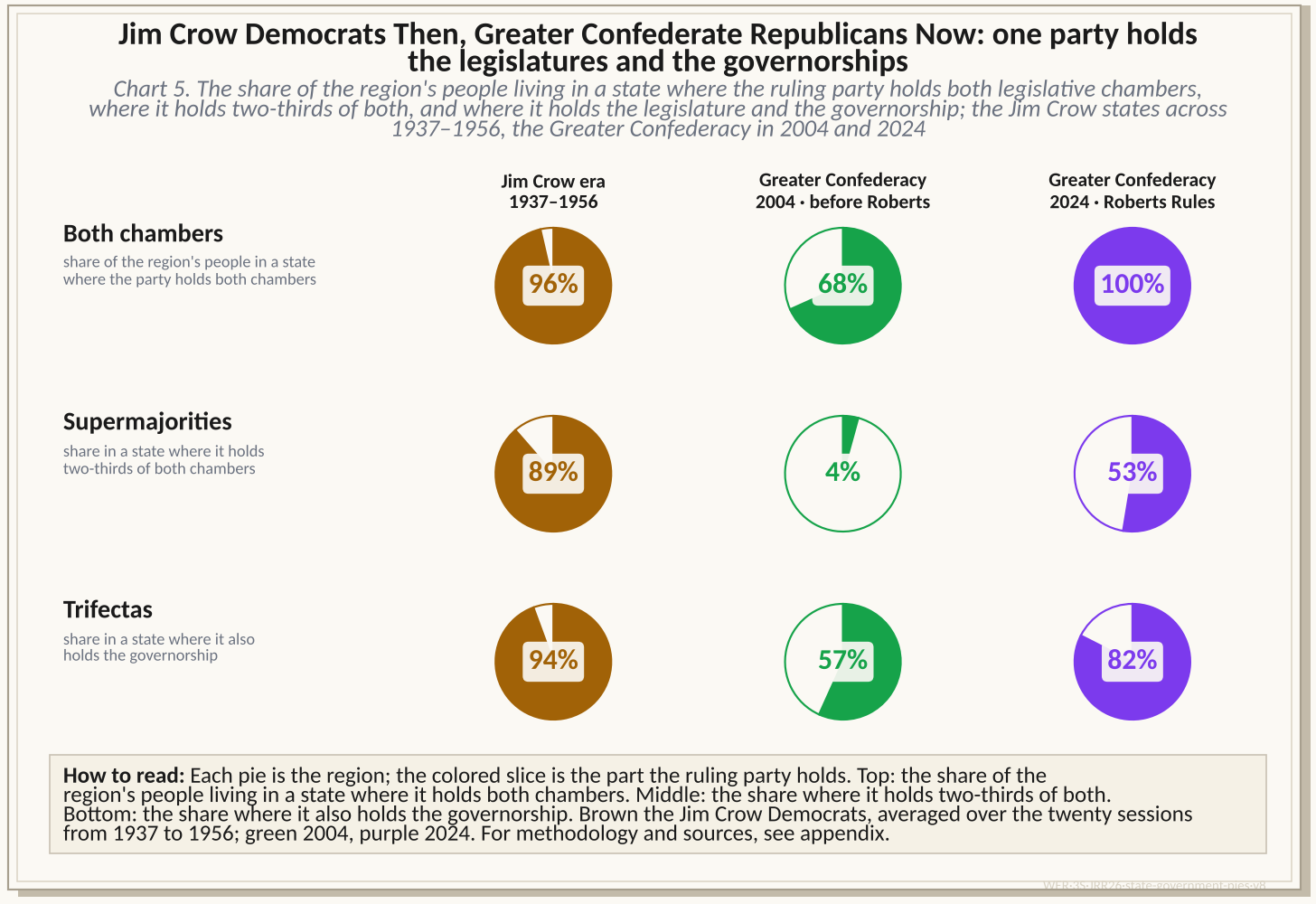
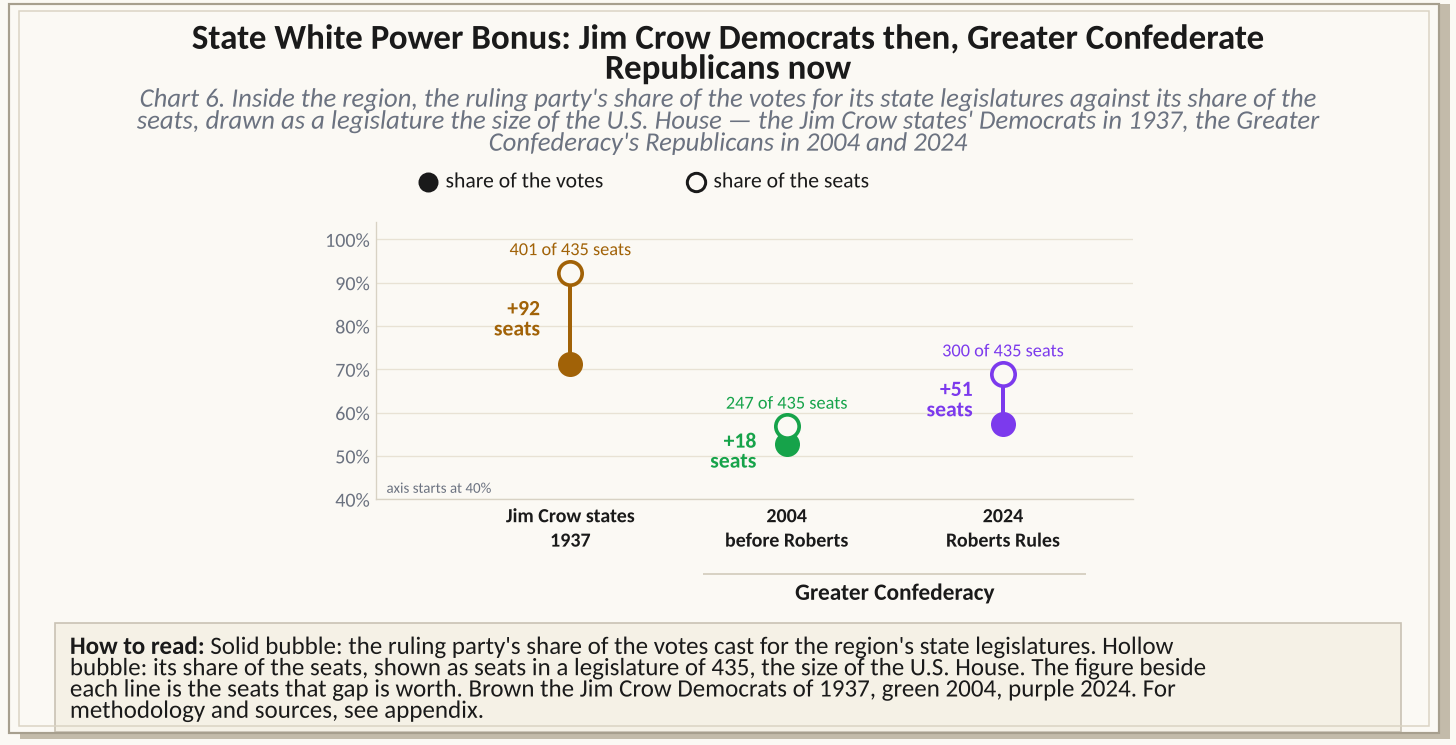
The Confederate white power bonus in Congress is drawn in the statehouses, which drew themselves a bonus of their own.15
(Note: Because the number of people in each legislative district varies widely from state to state, I’ve converted all the state house and senate seats into a virtual legislature with 435 seats to make it easily comparable to the House of Representatives.)
In 2004, Republicans won 53 percent of the vote for the region’s legislatures and 57 percent of the seats — relatively proportional. In 2024, a barely greater showing, 57 percent of the vote, yielded 69 percent of the state legislative seats — the equivalent of 51 “bonus” seats in a body the size of the U.S. House. The white power bonus in the Greater Confederacy’s statehouses has nearly tripled since 2004.
This is the perpetual power machine in action: state legislators, serving in the bonus seats, draw the maps that produce more bonus seats, for themselves and for Congress.
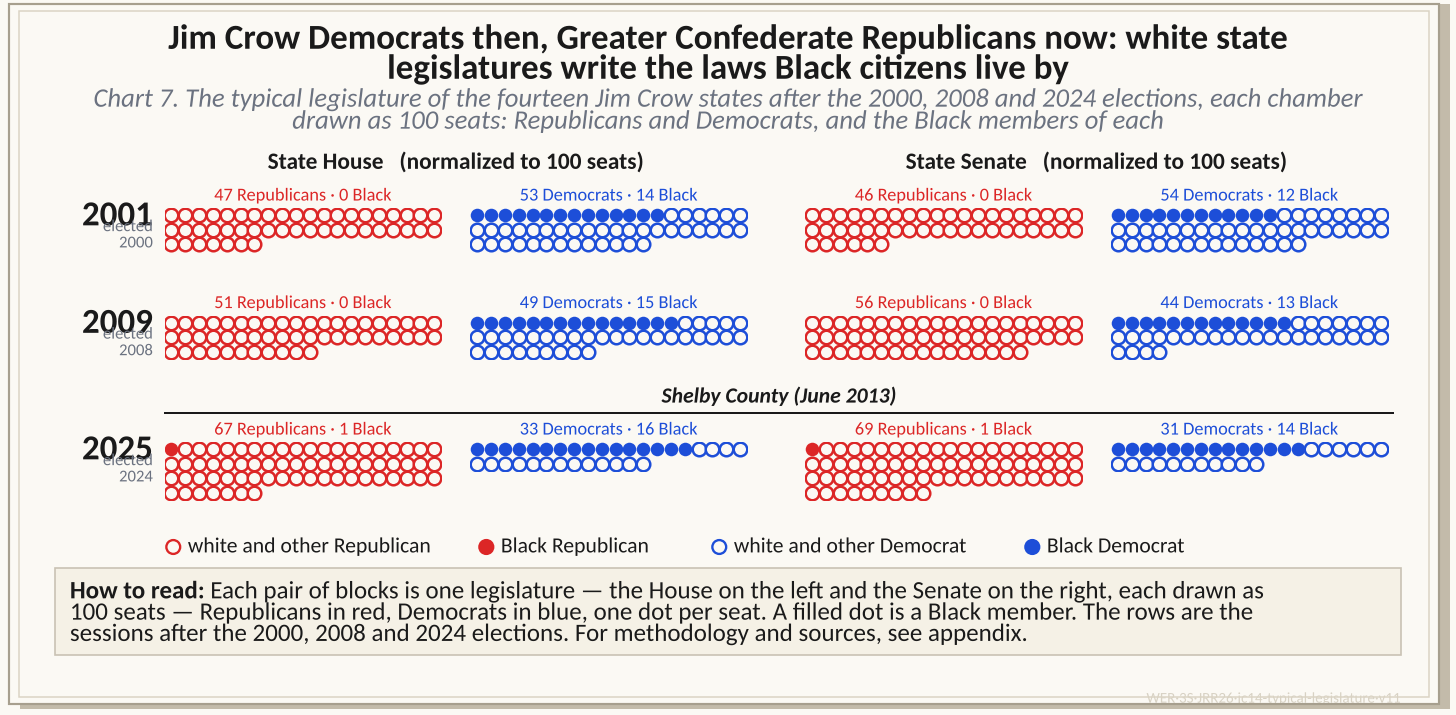
And the state legislative majorities those bonus seats built are almost entirely white. In the Jim Crow states that make up the Greater Confederacy’s core, control of the legislatures was close to evenly divided between both parties after the 2000 and 2008 elections. After 2024, however, Republicans held two-thirds of both chambers. Translated into a typical 140-member legislature, that would be 95 Republican seats, exactly one of them held by a Black member.
Those majorities write the laws for everyone in their states, and when Black-majority cities pass laws of their own, the legislatures often overrule or preempt them.16 As under Jim Crow, all-white majorities govern Black people who had no say in choosing them.
As during Jim Crow, the Greater Confederacy’s representatives advance an agenda that does not reflect the legitimate consent of the governed.
If that brings you up short, it’s because we tend to assume that Southern lawmakers are conservative because their voters are. But under Jim Crow, about a quarter of Southerners couldn’t vote at all, while the delegations claiming to represent them gained both seats and seniority from the people they disenfranchised.17
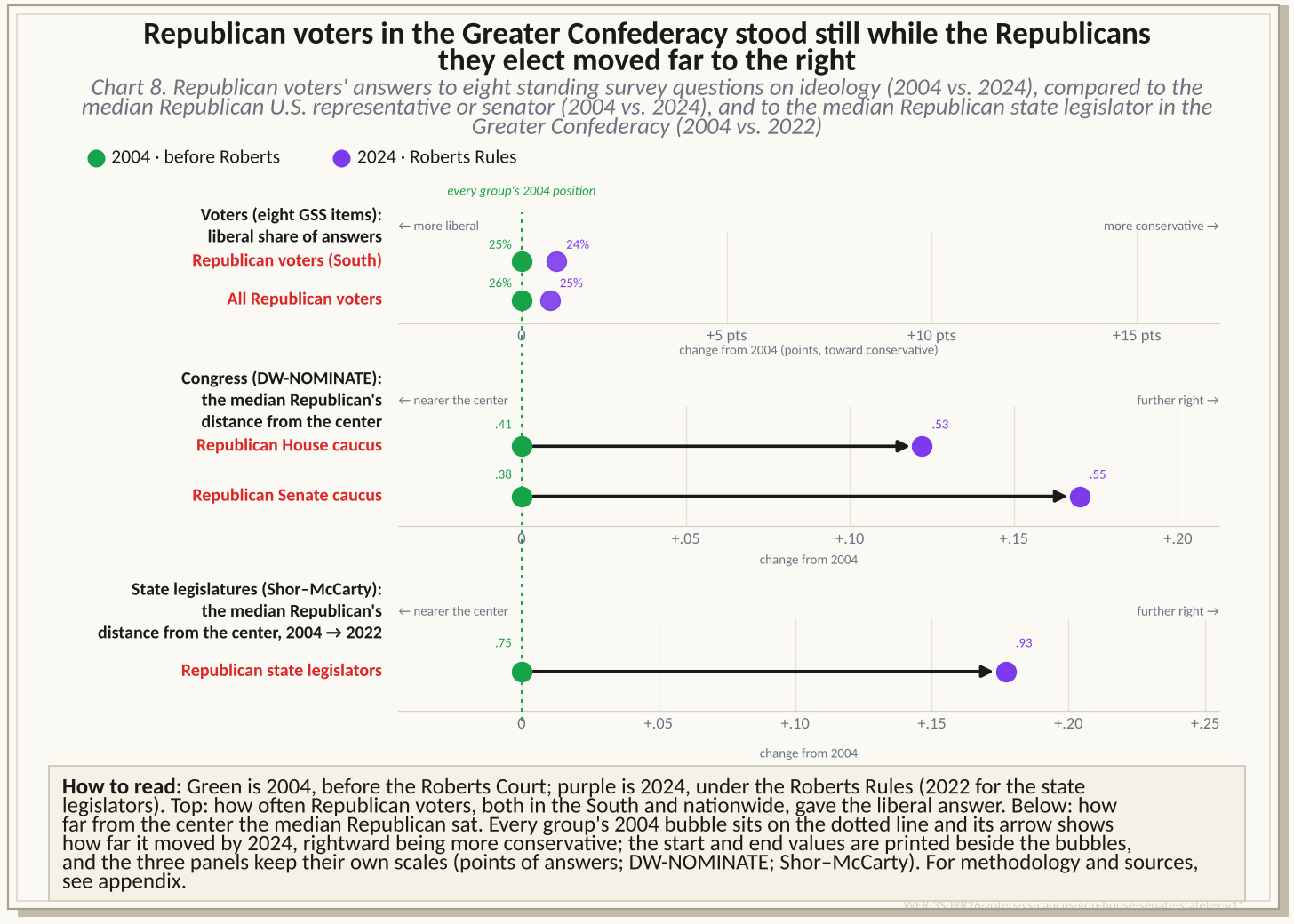
Today, the agenda that the MAGA coalition pursues in Washington and governs with at home is not popular. Over the last twenty years, Republican voters have not gotten much more conservative, either nationwide or in the South18 — but their representatives vote much more to the right (quantified by the standard measures, DW-NOMINATE for the House of Representatives and the Senate, and Shor-McCarty for state legislatures).19
In every one of the states in the Greater Confederacy, fewer than half of residents wanted Roe overturned.20 And where the Greater Confederacy’s voters have been allowed to decide for themselves, they’ve raised the minimum wage and expanded Medicaid over their legislatures’ objections, from Missouri to Florida. The legislatures answered by making ballot initiatives harder to qualify and pass.21
II. How the Roberts Rules Empowered and Unleashed the Confederates
How and why has all of this happened?
Consider that even the Nixon and Reagan landslides and the Gingrich Revolution delivered nothing close to the political and policy transformation that the MAGA coalition has achieved in the last 20 years with a president who didn’t even win a majority of votes cast. That wasn’t because the coalition’s earlier goals were more modest or because its institutions were newly constructed. By the mid-1990s, the Christian Coalition was a dominant force, the GOP’s Southern Strategy was well established, the Heritage Foundation was staffing Republican transitions, and the Federalist Society had built its judicial pipeline and cloaked “originalism” in respectability.
What held the coalition in check was the law (preclearance, limits on corporate election spending, courts that would still strike down a racial gerrymander) and the fact that the Republican caucus was still bisectional — it answered to New York and Pennsylvania as well as Georgia and Texas. That balance let the party’s establishment corporate interests, whose concerns were economic and national rather than regional, keep the religious right in check, because they had no interest in risking Republican majorities to advance a social agenda.
The Roberts Rules removed checks on the money and the lines, in several ways that would have been insufficient alone but together have been mutually reinforcing and devastating. I’ll discuss how that happened in roughly chronological order, but again, keep in mind that this is a cycle with many factors and feedback loops.
The Bush Wipeout Cleared the Brush
Breaking the sectional balance in the Republican Party started with something the coalition certainly didn’t intend: the 2006–08 backlash to George W. Bush cleared Northern and moderate Republicans out of the party. The seats Republicans lost in those two elections were nearly all outside the Greater Confederacy or belonged to the section’s less conservative members.
The House Republican caucus moved as far as any previous caucus has in either direction over those first four elections, and continued to move right while the House Democratic caucus hasn’t budged. The next chart shows this for the House Democratic and Republican caucuses, again using DW-NOMINATE, the standard measure of how liberal or conservative members of Congress vote.
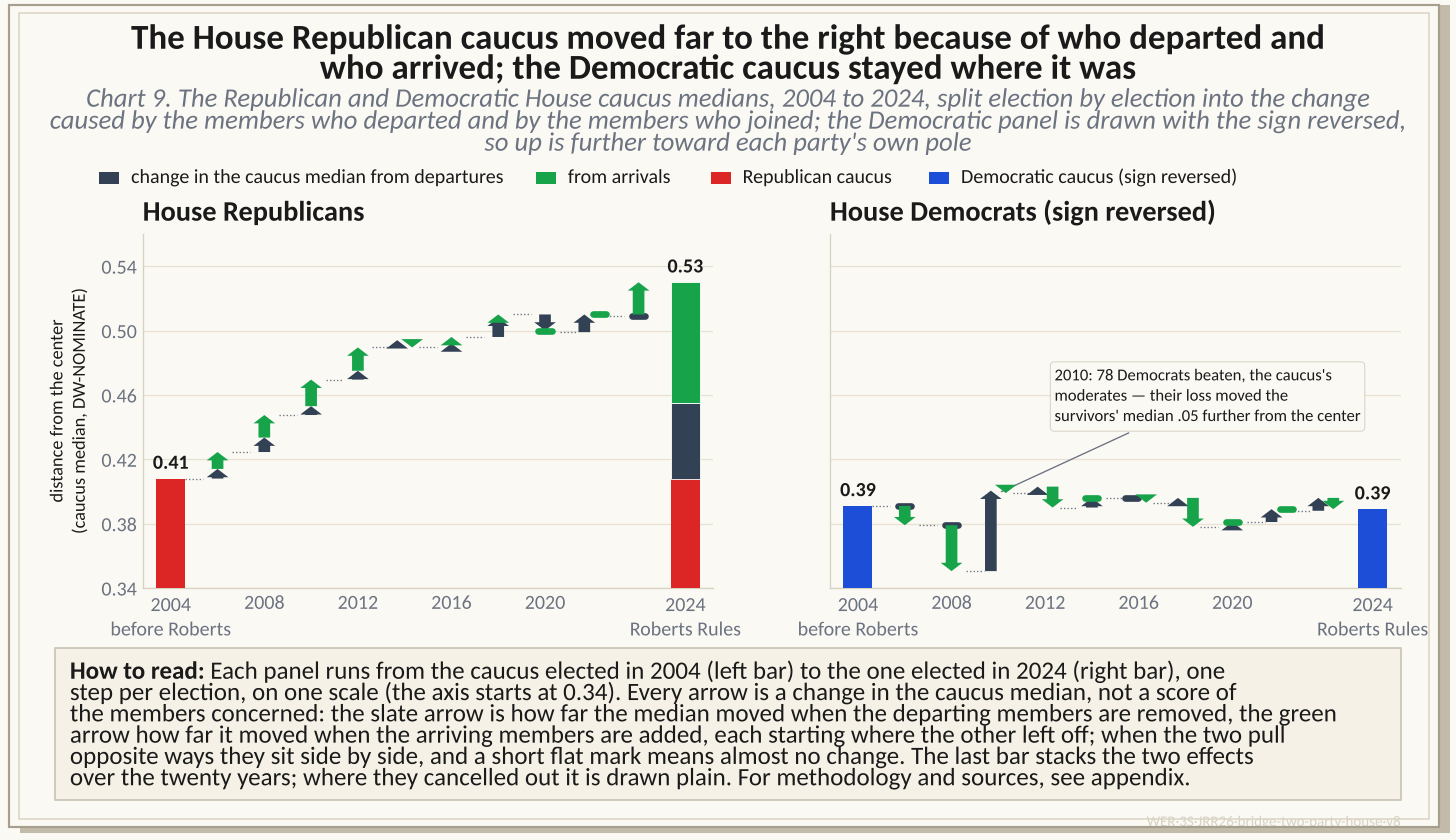
To read the chart, start with the Republican caucus in the left-hand panel. After nearly every election, departing members (the green segments), whether they retired or lost their primaries, were less conservative than the caucus as a whole, so their departure moved it right. The new members who arrived (the black segments) were further right still. Most of the shift to the right came before Trump.
The Democratic caucus, in the right-hand panel, shows just how asymmetrical this has been. Contrary to most people’s intuitions, the Democratic waves in 2006 and 2008 moved the party to the center, not the left. That’s what normally happens in a wave year because, by definition, the pickups are in seats that had been electing the other party. Then Democrats’ big losses in 2010 moved the caucus back to where it began, since the departures were its most moderate members.
We see the same dynamic for departing Republican members — but Republican newcomers consistently moved the party to the right, while Democratic newcomers consistently moved the party not much at all or to the center. We might expect to see Democrats moving to the left as they racked up seats outside the Greater Confederacy, but that’s not what happened. (This is because only Democrats now have real intraparty ideological and interest group competition; see footnote #9 about blue states for more.)
The 2006–08 Republican losses could easily have been ruinous. By 2009, the MAGA coalition was facing 60 Democratic senators and a large Democratic House majority. Under normal circumstances, the coalition would have been relegated to either a cranky faction inside a party it couldn’t control, or the master of a party that couldn’t win.
Leading Republicans well understood this danger at the time. Tom Davis, the Virginia moderate who had chaired the Government Reform Committee and had twice run the party’s House campaign arm, wrote a 2008 memo best remembered for quipping that “if we [the Republican Party] were dog food, they would take us off the shelf.” The memo also argued that the only way back was to “compete nationally and in swing districts” because “it’s all about the Independents, or we drop to a 170–180 seat permanent minority.” Two years after Davis retired that November, his party had its House majority back, and two years after that it kept the majority while losing the national vote. It did this while ignoring Davis’s advice to focus on swing districts and independents, and the people who had agreed with him were mostly gone.
The Roberts Court supplied the tools needed to make that happen in the nick of time.
The Money: Citizens United and the Political Company Town
Citizens United and related cases freed the plutocratic money and theocratic machinery of the MAGA coalition to take full advantage of both the 2006-08 opening and the 2010 backlash to Obama’s election. (Note: when I say “Citizens United” in this piece, it’s shorthand for that decision in combination with others that transformed our campaign finance system; see this footnote for more.22) The coalition seized the state legislatures that would control redistricting, filled the seats with its acolytes, and drew lines that changed the balance of power in the Republican Party.
Citizens United did this in two ways, the first obvious and the second less so.
First, Citizens United unleashed a sea change in campaign spending, and these changes raised the odds of a Republican winning a state legislative election.23
Second, Citizens United realigned the Republican Party’s funding base, and with it the balance of power in the coalition. Mainstream corporate interests had long been the GOP’s biggest funders, and its candidates usually prevailed. Even senior members of Congress from the Greater Confederacy, like Mitch McConnell and John McCain, were corporate Republicans. This, along with bisectional constraints, had kept the party from fully embracing the MAGA coalition’s agenda.
But after Citizens United, revanchist billionaires could claim the upper hand within the Republican Party over the more traditional Chamber of Commerce-style Republicans. Corporate and trade-association PACs mostly give to both parties, even when they favor one, and they still face contribution limits — $10,000 per candidate per election cycle. Nearly every major super PAC, and the largest donors to super PACs, use their unlimited funds entirely to benefit one party or the other. This cycle, conservative outside groups had already spent more than $2 billion by the end of October, Elon Musk alone having put in $445 million; by midyear, Republican candidates for Congress had received a combined $208 million from every PAC in America — corporate, trade association, labor and leadership PACs together.
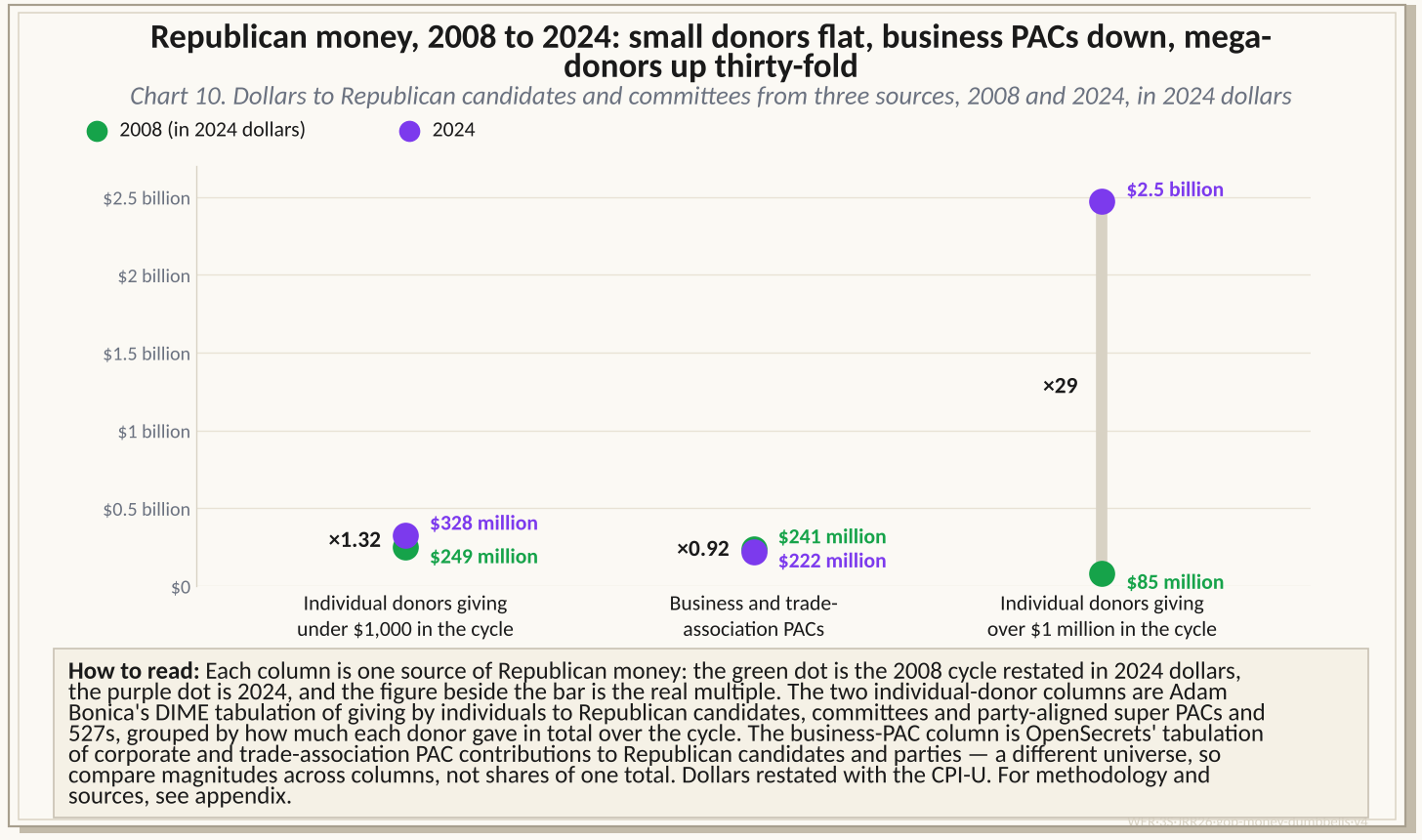
Remember, Musk and the other billionaires polluting our politics aren’t breaking the norms that prevailed before Roberts; they are breaking the laws that were in force before Roberts. Before the Roberts Rules, Elon Musk would have been limited to contributing $7,000 to any one candidate just as you and I are, compared to the nearly half a billion dollars he has already spent.

The party’s corporate old guard saw this realignment coming and tried to head it off. After the 2012 loss, the Republican National Committee’s leadership commissioned an “autopsy” that echoed Davis: the party had a wing that was “increasingly marginalizing itself,” and the way back was to move toward the center and compete everywhere. Twice in five years, leading Republicans had diagnosed the disease correctly and prescribed the normal cure. But that cure only works if a party needs to win outside its base, and the Roberts Rules had made sure this one didn’t.
Citizens United made the political company town much easier to build, and much harder to take down. As I mentioned earlier, most of the money in state and local politics doesn’t come from billionaires. Once one party has locked down the state government, the businesses and professionals who fund most state and local campaigns have no reason to back the other side, and few rising politicians are willing to spend their careers in a party that lacks power, support, or obvious paths to statewide office.24
What’s more, unlimited money doesn’t have to be spent to work; the threat of it alone often does the trick. In much of the Greater Confederacy, competitive races never happen because a potential challenger, whether a Democrat or a moderate Republican, never steps up for fear of being outspent.
This is why there is so little serious opposition to MAGA in the Greater Confederacy, even though so much of what these legislatures do is unpopular. An entrenched one-party system doesn’t just defeat the opposition; it starves it.25
The Lines: White Evangelical Opportunity Districts
The money explains how the MAGA coalition won the legislatures — but it doesn’t explain why the Republicans those legislatures sent to Washington were so much further right than the ones before them. For that, we have to look at the lines.
As we saw earlier, the Roberts Rules let Republicans cash in a bigger Confederate power bonus: 35 seats beyond what their votes warranted, up from 19 in 2004. That much of the story is familiar, thanks to reporting on Project REDMAP, the Republican plan to win the legislatures that would draw the post-2010 maps.26
But those legislatures didn’t just rack up more seats for Republicans, which is usually all we think gerrymandering does. They drew districts to advantage MAGA Republicans. They did that by creating white evangelical opportunity districts, drawn at the expense of Black and urban voters.
White evangelicals are about 18 percent of voters and an even smaller proportion of Americans, 13 percent — but about half of Republican primary voters in the Greater Confederacy, and over 60 percent in its rural areas. A group that makes up less than one-fifth of the electorate picks the nominees for most of the majority party.
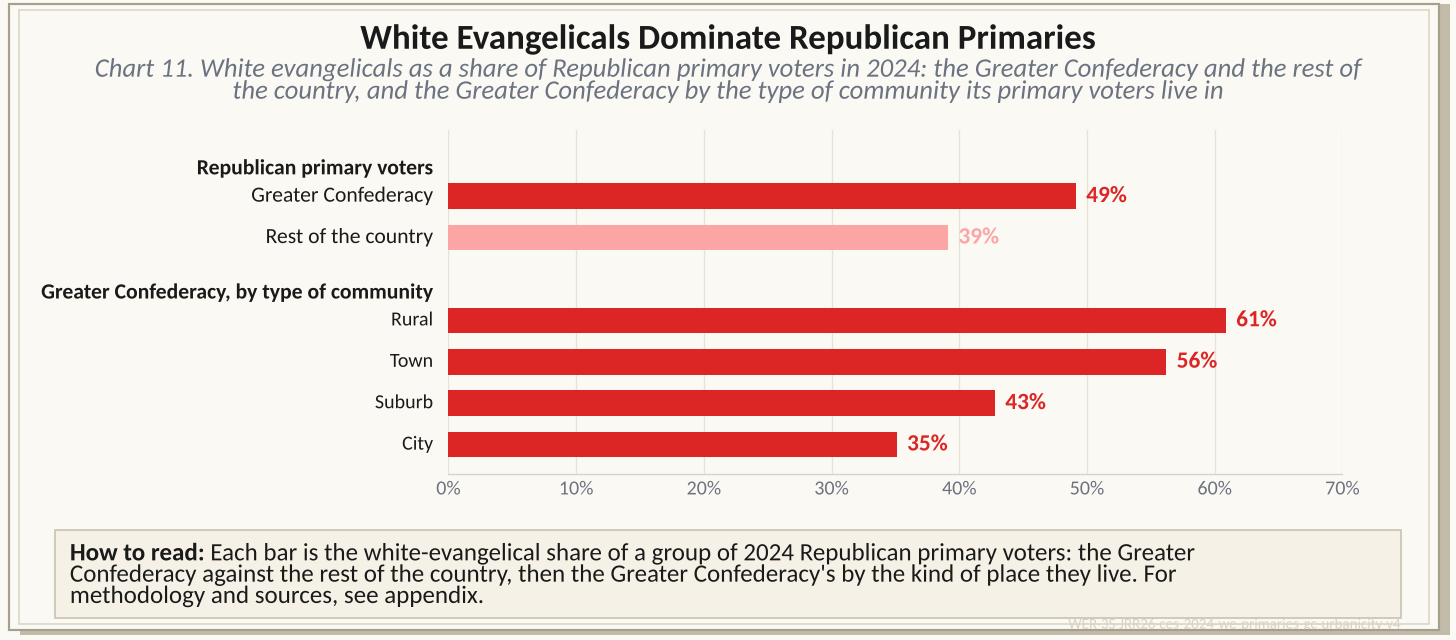
This didn’t happen by chance and was not inevitable. By the 2000s, many white evangelical churches were already deeply political, and their members already voted overwhelmingly Republican by roughly three to four to one in the 21st Century. And right-wing plutocrats like the Kochs were much more interested in total deregulation than in the stability that companies like GM wanted. But before the Roberts Rules, white evangelical voters and revanchist billionaires alike mostly had to settle for establishment, Chamber of Commerce-backed Republicans who could raise the money to run competitive races. Once billionaires could spend without limit after Citizens United, however, they could back the religious right’s candidates directly — candidates who were also willing to go much further against regulation, taxes, and unions than the Chamber’s ever had.
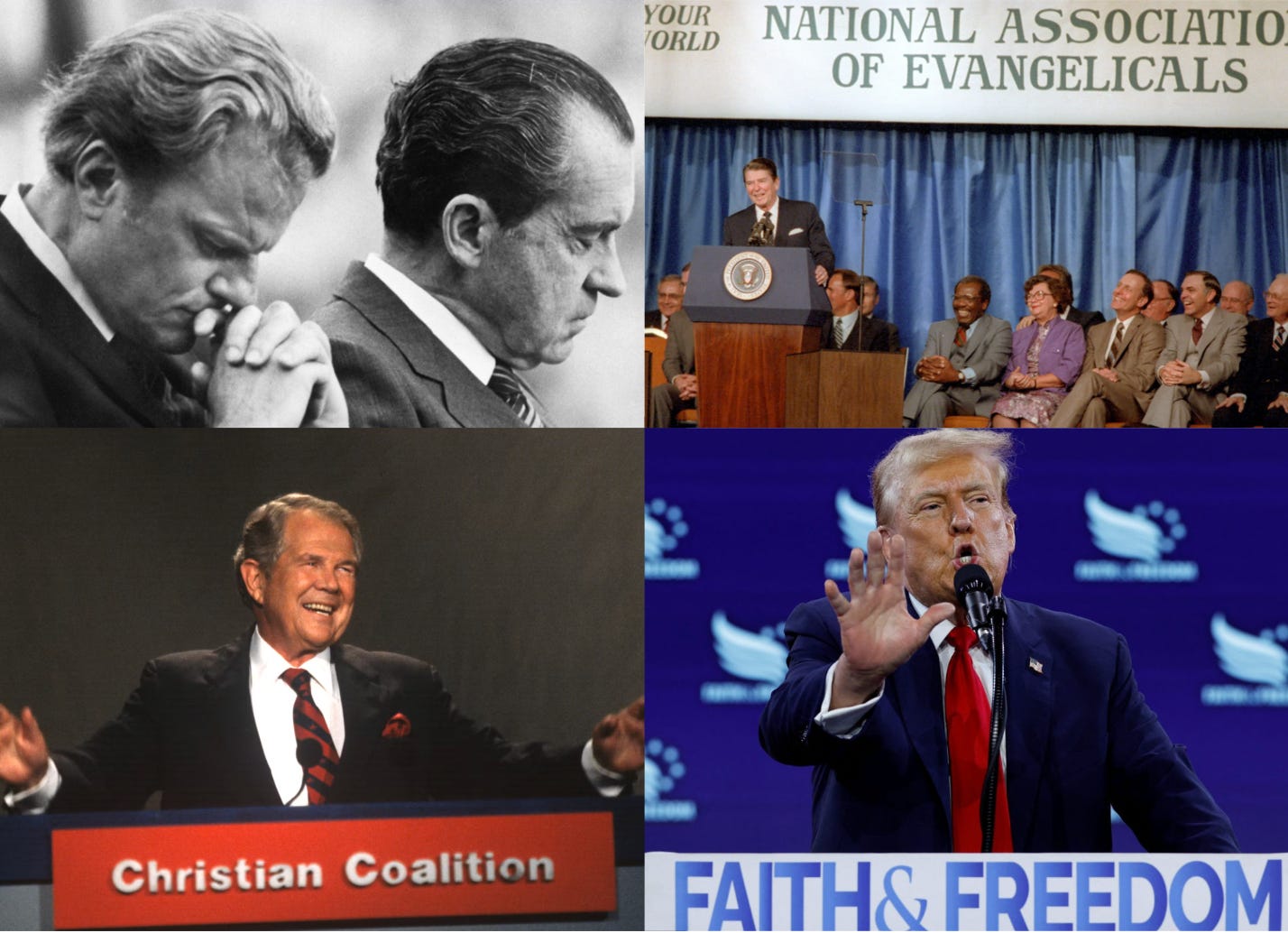
You can see the shift in the primaries. The 2010 elections weren’t only a backlash against Obama; they were also a white evangelical backlash against “RINOs.” From 2010 through 2022, a historically high number of House Republicans lost their primaries, the vast majority of them in the most evangelical districts. Before 2010, successful challenges had been rare in those districts, as they still are in the least evangelical ones.
The result, as I explained in this 2023 post, is a white Christian nationalist House Republican caucus. Its Speaker is a devout white evangelical, and three-quarters of the Republicans who voted against certifying the 2020 election represent the most evangelical two-fifths of districts.
The next chart shows how dramatically the makeup of the Republican House caucus changed once the Roberts Rules were in effect. It sorts House districts into fifths (quintiles) by white evangelical density. The pie charts on the left show that between 2000 and 2024, Republicans went from winning 68 percent of the most evangelical quintile of districts to winning almost all of them, 96 percent, while their hold on the least evangelical quintile shrank from 34 to 17 percent. The stacked red bars on the right show what that did to the caucus, both in terms of share of the Republican caucus (the size of the segments) and ideology (deeper red is farther right).
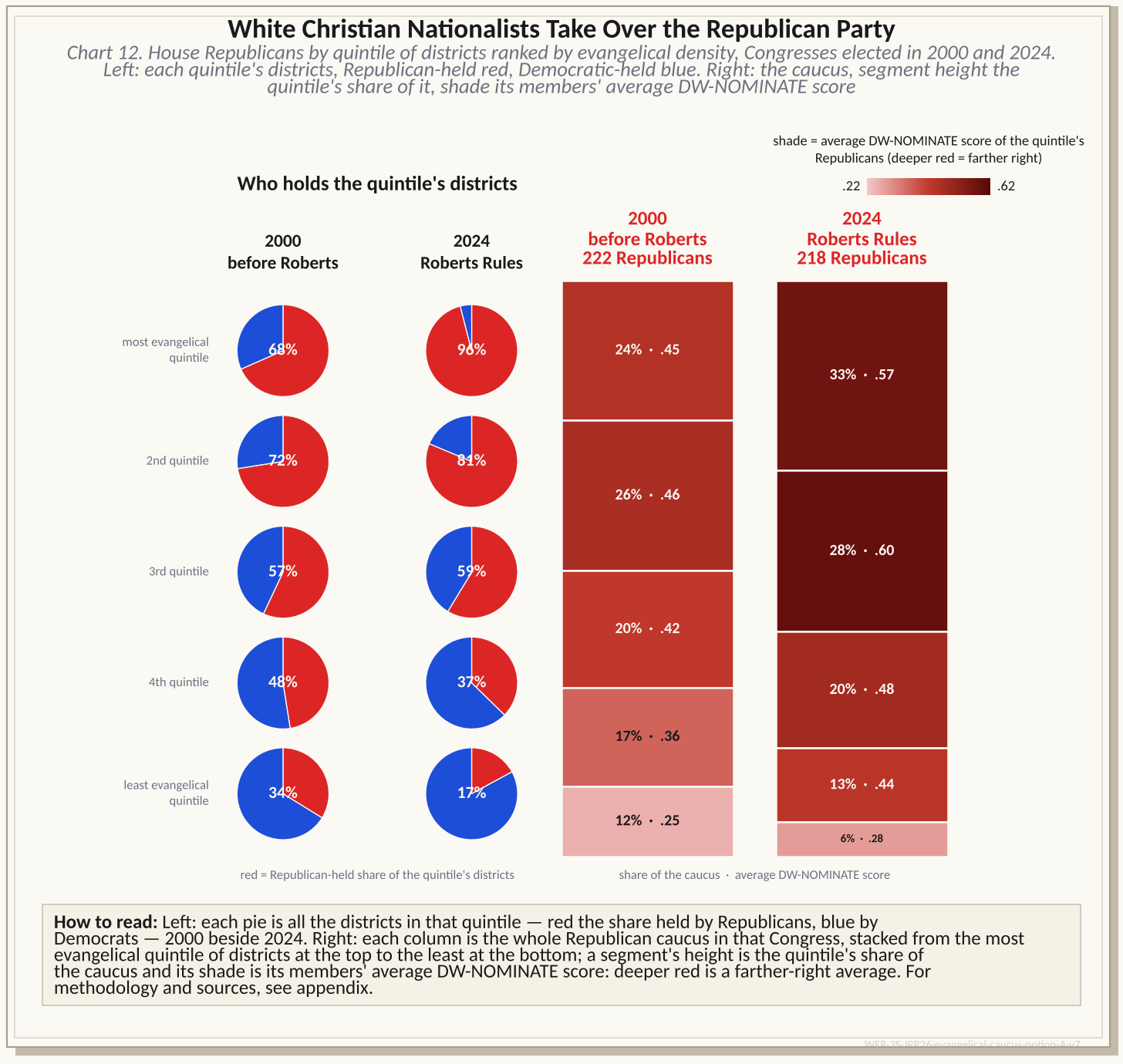
The most evangelical districts now make up a much larger share of the caucus, and the members from those districts are also much further right than the members who held those districts before. The newcomers were further right because white evangelical voters now dominate the primary electorates choosing them.
Republican representatives now routinely prioritize the white evangelical agenda over the wishes of their constituents, even other Republicans, as the chart below indicates.27
The views of evangelicals (darkest bubble) who pick the nominees are far more right-wing than everyone else in the Greater Confederacy on many key issues: 33 points above the average among the section’s adults on banning abortion, 31 on saying Christianity is under assault, 41 on strongly approving of Trump. The other Republican primary voters (bright red) and other Republican voters (pink) in the same districts were much closer to the region’s average than to evangelicals on religion and ideology, but close to the evangelicals on deportations, taxes, and the minimum wage.
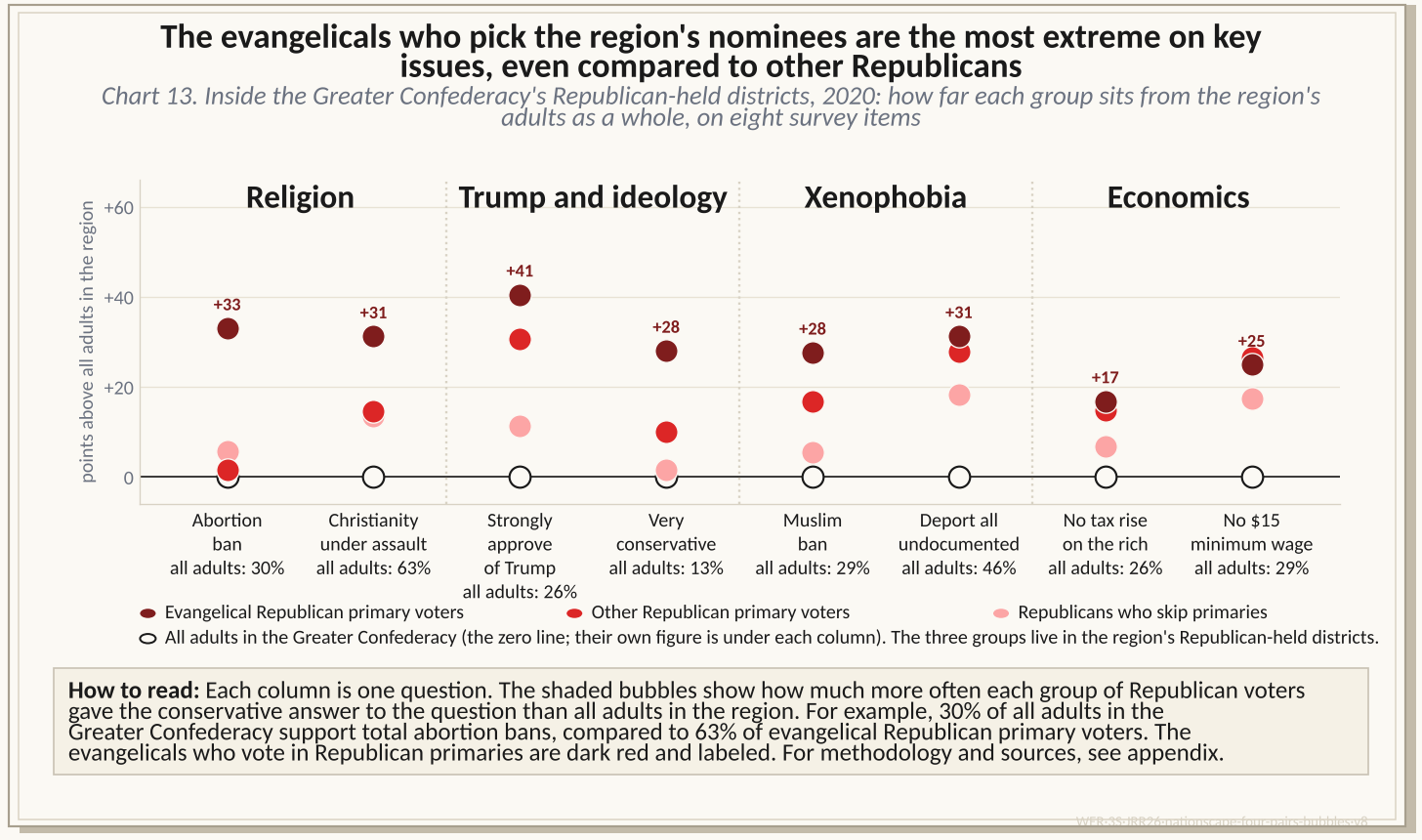
In other words, Republican members of Congress don’t represent the people in their districts, or even, on the issues the evangelicals care about most, the other Republicans there. They represent the white evangelical churches that organized and deployed their congregations to put them in office.
Shelby and Beyond: No Appeal and No Way Out
The legislatures’ first new maps and voter suppression measures did not survive the courts, until the Roberts Court got involved, with a series of rulings from Shelby County in 2013 to Callais this year.28
Shelby rested on a principle of “equal sovereignty” among the states that Richard Posner — a Reagan appointee and the most-cited federal judge of his generation — said he had never heard of: “there is no doctrine of equal sovereignty. The opinion rests on air.” And in doing so, Roberts only thinly rebranded the principle of “states’ rights,” which had been twice discredited — first by the Civil War, and then by the set of constitutional and legal changes made in the 1960s.
Within hours of Shelby, Texas announced its voter-ID law, which had previously been rejected in federal court, would take effect. And Callais revived the “intent” test Congress rejected in 1982 — the one a 26-year-old John Roberts had fought to keep.29
Once the Court effectively ended preclearance with Shelby County, the legislatures used their lock to make their power even more voter-proof.
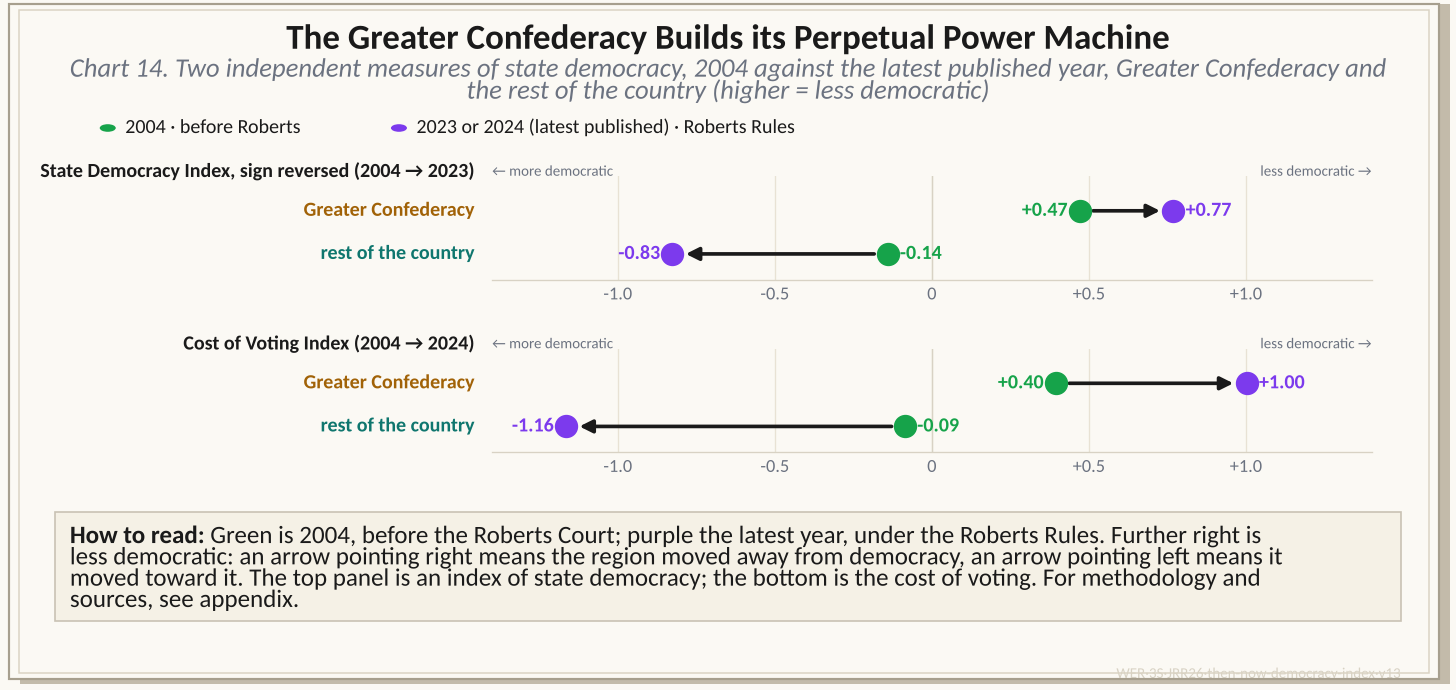
In 2004, the Greater Confederacy and the rest of the country weren’t far apart on two independent measures of state democracy: one of overall democratic health, and one of the “cost of voting” (which also includes non-monetary costs, such as the time people have to spend waiting in line to vote). But since then, the Greater Confederacy’s legislatures have made voting harder and their states less democratic, while the rest of the country has done the opposite.30 (For more on this subject, read my 2024 piece on how “Shelby County Opened the Door to Modern-Day Poll Taxes.”)
Residents had few ways to fight back. Six in ten of the region’s residents live in states with no citizen-initiated ballot measures, and 12 million live in the three states that elect their governors in odd years, when turnout is lowest — both legacies of Jim Crow.31
That left the courts. Today, 96 percent of those in the Greater Confederacy live in a state with a Republican state supreme court majority.32
Electing a Democratic governor can’t reverse the legislatures either, because a captured legislature can take the office’s powers away before a new governor can use them. North Carolina is the textbook example. In December 2016, in the weeks between Roy Cooper’s victory over Pat McCrory and his inauguration, the Republican legislature met in a special session and stripped the governorship of the powers it had been content to let McCrory hold.(fn)33
Meanwhile, at the federal level, any attempt to reverse the Roberts Court’s rulings, or hold the justices accountable, is blocked by the same Republican senators who confirmed most of its majority, but who represent less than half of the U.S. population. About 80 percent of the votes to confirm all six of its justices nominated by Republican presidents (five of whom were nominated by presidents who first took office after losing the popular vote), and more than 90 percent of the votes for the three most recently confirmed justices, came from Greater Confederacy senators. Those senators are funded by the same billionaires who financed the Federalist Society project to pack the Court, and were mostly nominated by the same white Christian nationalist primary voters who chose their House colleagues.
Conclusion: The 2026 Midterms
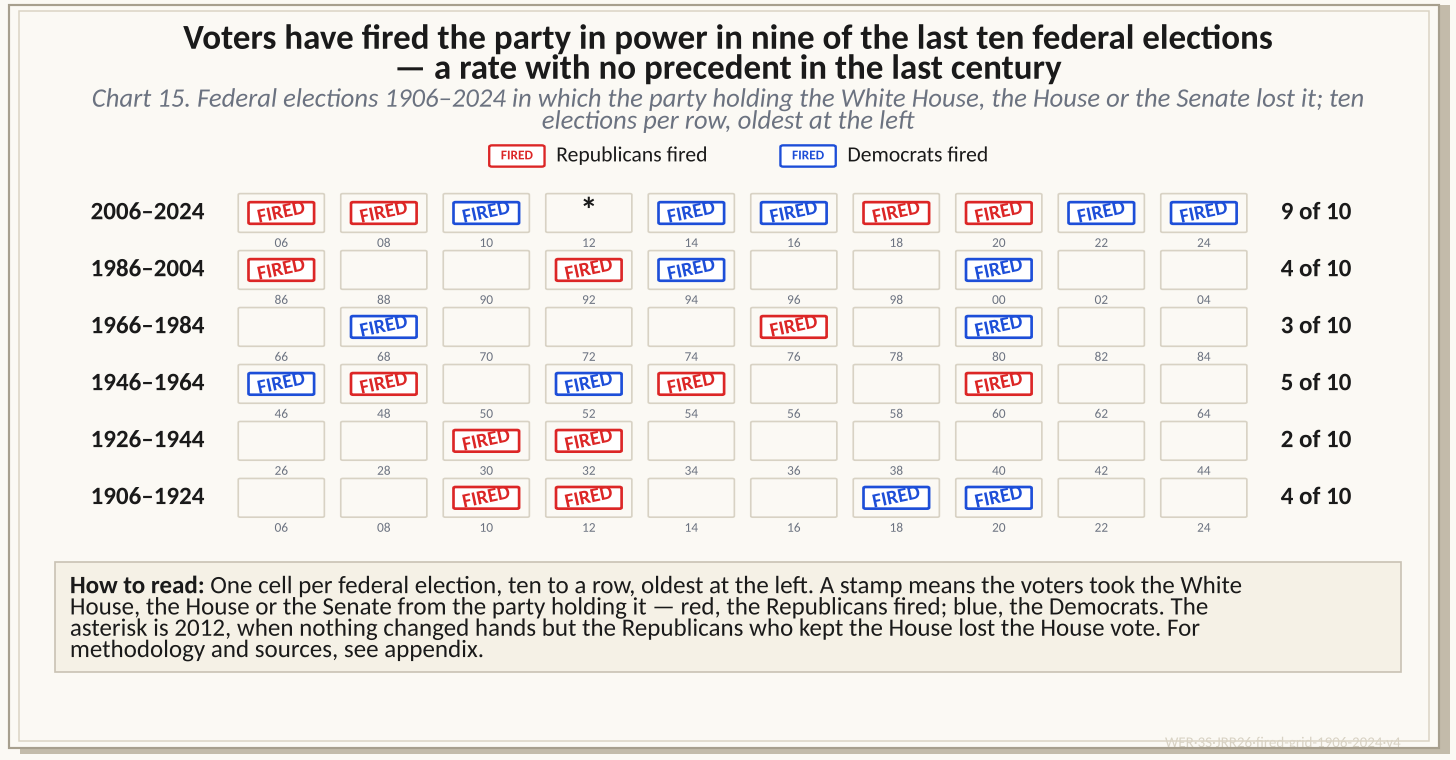
Voters have fired the party in power in nine of the last ten federal elections — a rate with no precedent in the last century, when the long-run norm was three or four in ten. They are about to do it again, presuming that Trump and MAGA fail in their efforts to keep Democratic votes from counting. It will be reported as a “Blue Wave,” and there will be a rush to declare victory for “democracy.” (This is what happened after the 2022 midterms were not as bad for Democrats as expected, even though control of the House had passed to a clearly fascist, election-denying party, and across the Greater Confederacy, state legislatures had enacted draconian voter suppression and subversion laws.)
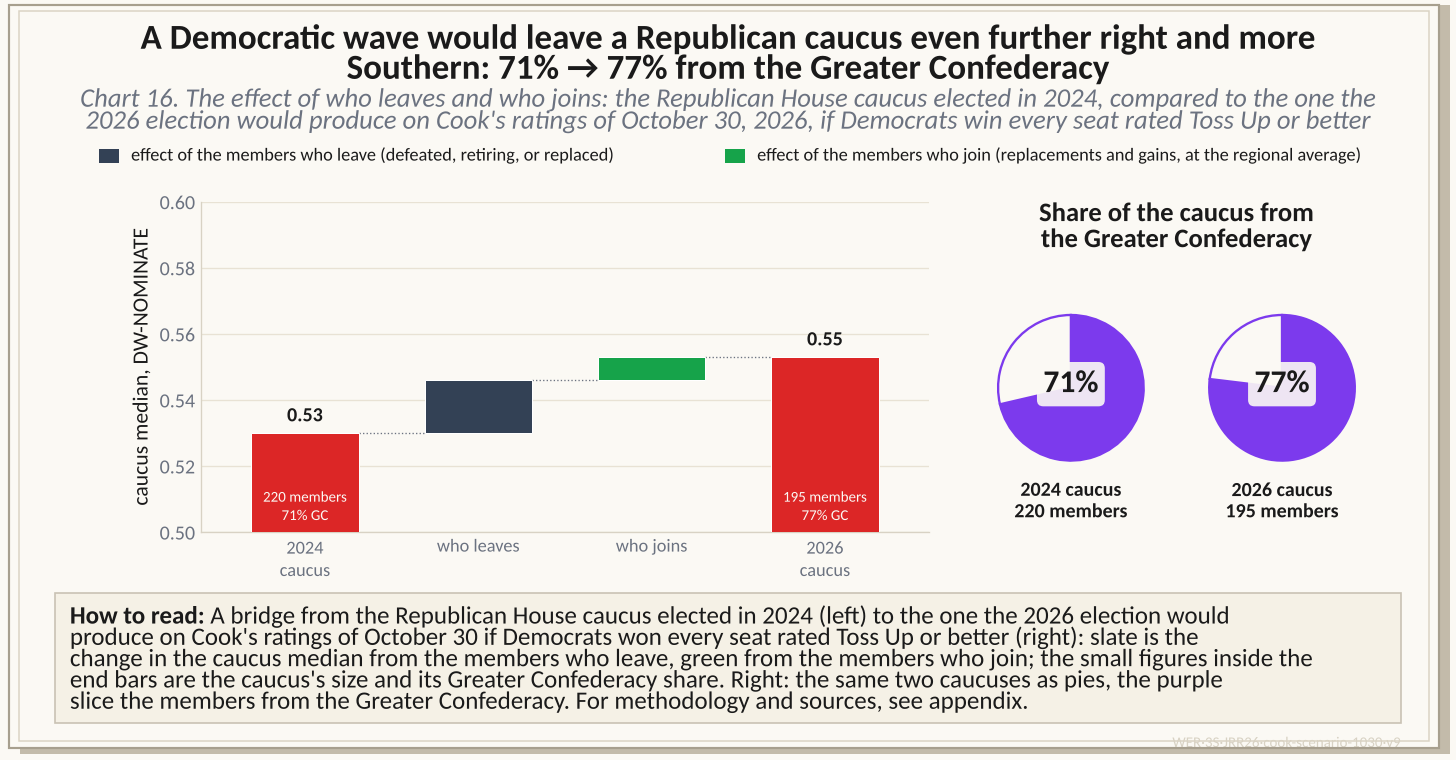
But most of the seats Republicans lose will be the ones the MAGA coalition can most afford to lose. On the Cook Political Report’s ratings as of October 30, if Democrats win every seat rated a toss-up or better, Republicans lose 31 seats, 18 of them outside the Greater Confederacy, and gain seven, six of them inside it. The caucus that returns in January would be smaller — 196 members instead of 220 — but even more sectional (77 percent from the Greater Confederacy, up from 71), more evangelical, and further to the right. The Confederate Realignment will have advanced, not retreated, on a night the voters rejected it. And it will be further extended in 2028, when the Greater Confederacy states that didn’t redraw their lines this year do so next.
The seats it keeps are protected by a bonus no wave can reach for long, drawn by legislatures no wave can flip for long — the perpetual power machine, running as designed. To be clear, Republicans seem poised to narrowly lose chambers in some of the Greater Confederacy. But holding them will depend on an equally Democratic year in 2028, and even that will be far from enough to dismantle the perpetual power machine.
We have been here before, and the lesson of the last time is that Jim Crow was not dismantled by an election. It was dismantled by people who first insisted on calling it what it was, and then spent decades building the institutions — the civil rights movement, the unions, the churches that chose the other side — that could take it apart piece by piece, until a Congress and a Court finally had to act.
The order the Roberts Court has licensed rests on a handful of rules, written by a handful of judges, that a determined majority can rewrite — but not until that majority understands that the problem is not polarization, or messaging, or simple procedural reform, or the voters. The problem is who has power.
Nothing short of a third reconstruction is in order. Those who sponsored the Roberts Court and the Republican Party must lose the power they’ve stolen from the rest of us — and we must not only take our power back, but wield it without fear or favor.
Appendix - Data Sources and Methodology
For the sake of brevity, the sources below are grouped by topic rather than chart by chart, since the same source often underlies several charts.
With one exception (Chart 4, which relies on the proprietary Catalist voter file), every figure in this piece can be traced to a public dataset or an official return. The 27-state roster of the Greater Confederacy is applied year by year to all of them.
A note on visualizations: Behind every chart here are many judgment calls. Even something as simple as “how many Republicans were in the House” depends on whether you count the members elected in November or those seated after deaths and special elections, how you treat independents, and so on. However, the differences in these charts are large enough to hold up whichever reasonable choices one could make on such factors. They’ve each been confirmed with at least two independent sources wherever possible, and I’ve refrained from reaching conclusions that would depend on cherry-picking data.
Congress:
Members’ voting records are from Voteview (Lewis, Poole, Rosenthal et al.), the DW-NOMINATE scores, and member rolls for every Congress; caucus figures use the members seated after each November election.
House vote shares are from the official returns by district, 1920–2024; Senate shares from the official returns by state. The 1924 comparison uses the county presidential returns compiled by Sharif Amlani and Carlos Algara, because most Southern House seats were uncontested, and would therefore undercount the extent of Southern support for Democratic House candidates as a percentage of support for Democratic candidates nationally.
The “Callais lines” counterfactuals use The Downballot’s 2024 presidential vote by 2026 district. The midterm scenario uses the Cook Political Report’s House ratings of October 30, 2026.
Primary challenges to incumbents are from the Pettigrew, Owen and Wanless (1956–2010) and Miller and Camberg (2012–2018) House primary files; challengers’ ideology from Adam Bonica’s DIME recipient scores.
Retirements and defeats are from the House Press Gallery casualty lists and Ballotpedia; committee chairs from Congressional Research Service rosters.
State legislatures and courts:
Seats and chamber control are from Carl Klarner’s State Partisan Balance data through 2011 and the National Conference of State Legislatures’ partisan-composition tables for 2023 and 2025; votes are from the Handan-Nader, Myers and Hall state-legislative file, 1992–2022; legislators’ ideology from Shor and McCarty’s Aggregate State Legislator Ideology Data (January 2025 release).
Black membership is from the Joint Center for Political and Economic Studies (2001), NCSL (2009) and the Rutgers Center for American Women and Politics with the state legislative Black caucuses (2025).
State supreme court majorities are from the courts’ own rosters: as of July 1, 2025, compiled justice by justice from Ballotpedia’s justice profiles and annual vacancy reports, state court websites and secretaries of state. For each state, the court of last resort for civil matters is counted (Texas’s and Oklahoma’s separate criminal courts are excluded). A justice is counted as Republican if first seated by a Republican governor’s appointment or, for elected justices, if a party label appears on a ballot, registration, nomination, party endorsement, prior partisan office or the justice’s own statement; justices with neither are not counted. South Carolina’s justices are elected by the General Assembly and carry no party label on this basis. Counting them with the Republican legislature that elected them gives 96 percent of the Greater Confederacy’s population; excluding South Carolina gives 92 percent. Population weights are Census Bureau 2025 estimates.
Population weights are Census Bureau estimates throughout, with the Gibson and Jung historical series for years before 1970.
Voters:
Republican voters’ opinions are from the General Social Survey, 1972–2024 cumulative file (NORC).
The white evangelical share of primary voters is from the Cooperative Election Study, 2024 common content with validated vote, and its 2006–2025 cumulative file.
The issue comparison of evangelical primary voters with their neighbors is from the Democracy Fund + UCLA Nationscape survey, 2020.
State opinion on Roe is from PRRI’s American Values Atlas; the national shares of white evangelicals from PRRI’s Census of American Religion and Pew’s 2024 validated-voter study.
Who is represented by their group’s chosen candidate is computed from the Catalist voter file for the 2008 and 2024 elections. Turnout and registration by race are from the Census Bureau’s Current Population Survey Voting and Registration Supplement, November 2008 and 2024.
Where voters’ views are compared with their legislators’ over time, the American National Election Studies cumulative file and 2024 study, and the state policy-mood series of Lagodny, Jones, Koch and Enns (State Politics & Policy Quarterly, 2022), are used.
Religion and geography: Evangelical density by district is calculated from the U.S. Religion Census (RCMS) for 2000 and 2020, via the Association of Religion Data Archives, allocated from counties to congressional districts. Evangelical churches include LDS churches and exclude Black churches for this project; rural and urban classifications follow Jed Kolko’s county typology, with the CityLab Congressional Density Index and Census land areas for district-level density.
Democracy and voting rules: Jacob Grumbach’s State Democracy Index, 2000–2023; the Cost of Voting Index (Li, Pomante and Schraufnagel), 1996–2024; Loyola Law School’s All About Redistricting for who draws the lines; NCSL and Ballotpedia for initiative and referendum provisions.
Money: Outside spending, super PAC totals and top donors are calculated from OpenSecrets data; independent expenditures in primaries from the Federal Election Commission’s bulk files, and candidate and party receipts from the FEC’s 24-month summaries; dollars are adjusted with the BLS consumer price index where stated.
Greater Confederacy definition: Consists of 27 states: 14 of the Jim Crow states (Alabama, Arkansas, Florida, Georgia, Kentucky, Louisiana, Mississippi, Missouri, North Carolina, Oklahoma, South Carolina, Tennessee, Texas and West Virginia) as well as Alaska, Arizona, Iowa, Idaho, Indiana, Kansas, Montana, North Dakota, Nebraska, Ohio, South Dakota, Utah and Wyoming.
Crucially, the standard for inclusion is not how each state’s citizens vote, but that the organized interests have a durable lock on the state legislature and have entrenched a legal regime that defends itself from electoral accountability and perpetuates its power. Membership is therefore time-dependent: a state joins when its regime is captured and leaves if it no longer is.
A third partner has joined more recently: the tech moguls, the robber barons of our day, who want AI developed on their terms and without public interference, and who have found that the MAGA coalition’s political base is the surest guarantee of that.
Further reading:
On the billionaires’ campaign: Jane Mayer, Dark Money (2016); Nancy MacLean, Democracy in Chains (2017); Kim Phillips-Fein, Invisible Hands (2009); Anne Nelson, Shadow Network: Media, Money, and the Secret Hub of the Radical Right (2019). The Lever, Master Plan (2025)
On the theocrats’ campaign: Katherine Stewart’s books, The Power Worshippers (2020) and Money, Lies, and God (2025); Robert P. Jones’s books, White Too Long (2020), The Hidden Roots of White Supremacy (2023), and Backslide (2026); Andrew Whitehead and Samuel Perry, Taking America Back for God (2020); Philip Gorski and Samuel Perry, The Flag and the Cross (2022); Randall Balmer, Bad Faith: Race and the Rise of the Religious Right (2021); Tim Alberta, The Kingdom, the Power, and the Glory: American Evangelicals in an Age of Extremism (2023).
On the Federalist Society and the capture of the judiciary: Lisa Graves, Without Precedent (2025); Senator Sheldon Whitehouse, Captured (2017) and The Scheme (2022); David Daley, Antidemocratic (2024); Jane Mayer, Dark Money (2016); Steven Teles, The Rise of the Conservative Legal Movement (2008); Amanda Hollis-Brusky, Ideas with Consequences: The Federalist Society and the Conservative Counterrevolution (2015); Michael Avery and Danielle McLaughlin, The Federalist Society: How Conservatives Took the Law Back from Liberals (2013).
The Roberts Rules, the bundle of decisions this piece refers primarily (but not exclusively) to: Citizens United v. FEC (2010); Shelby County v. Holder (2013); Rucho v. Common Cause (2019); Brnovich v. DNC (2021); Trump v. United States (2024); and Louisiana v. Callais (2026). Taken together, they changed the most fundamental ground rules of democratic elections — money, maps and the vote itself — without a single vote in Congress. For more detail on this argument, see “The John Roberts Election,” Weekend Reading and “Change No One Would Have Believed,” Weekend Reading.
On the Religious Right’s organizing infrastructure:
Local churches don’t do this alone. Around them is an infrastructure that has no counterpart on the other side of the aisle. As Pew reported in Religious Radio Across America: Religious programming is now the most common radio format in America — in February 2026 it passed country, which had held the top spot for eleven years — with more than 4,000 full-power stations, and the Greater Confederacy is where they are densest: 30+ percent of all the AM and FM stations in Nebraska, Kansas, Texas, Alabama, Georgia, Louisiana, North and South Carolina, and Florida are religious. Texas alone has 433 of them. Two networks, Salem and American Family Radio, carry the political talk to roughly 3,100 affiliates and 180 owned stations. The non-music component to these religious stations includes organizations with a deep network of influence: Focus on the Family’s political branch, the Family Policy Alliance, operates in 39 states, with what the network describes as 55,000 direct church relationships. Turning Point USA’s Faith arm claims 12,000 churches and pastors.
Off the radio, religious advocacy groups like the Faith and Freedom Coalition report 120,000 church contacts and 3 million voter guides in the 2024 cycle. In court, Alliance Defending Freedom has been counsel of record in 20 Supreme Court wins since 2011 and First Liberty is 11–0.
And inside the sanctuaries themselves, Pew found that seven in ten white evangelicals heard a political sermon in 2020. The movement has its own media, its own law firms, its own lobbyists in every capital, and a pulpit in every county.
The Greater Confederacy consists of 27 states: 14 of the Jim Crow states (Alabama, Arkansas, Florida, Georgia, Kentucky, Louisiana, Mississippi, Missouri, North Carolina, Oklahoma, South Carolina, Tennessee, Texas, and West Virginia) as well as Alaska, Arizona, Iowa, Idaho, Indiana, Kansas, Montana, North Dakota, Nebraska, Ohio, South Dakota, Utah and Wyoming.
Crucially, the standard for inclusion is not how each state’s citizens vote, but that the organized interests have a durable lock on the state legislature and have entrenched a legal regime that defends itself from electoral accountability and perpetuates its power. Membership is therefore time-dependent: a state joins when its regime is captured and leaves if it no longer is.
In earlier pieces I called this region the “Neo-Confederate States” or “Red Nation,” and the boundaries have been refined since; the name has changed, the argument has not. (I discuss the problems with “red/blue” framing in this piece, and “Neo-Confederate” suggests a fringe movement or something new, when this is about the same ruling interests, pursuing the same project, across a territory that has grown.)
This is true of Citizens United, Shelby County, Rucho and Trump v. United States, which are constitutional holdings.
Roberts was confirmed September 29, 2005. Under the law on that date, corporate and union treasury spending on independent expenditures in elections was barred, plus soft money expenditures by for-profit and non-profit corporations that tried to go around campaign funding limits were also restricted (Abood, 1977; Austin, 1990; McConnell, 2003); every change to voting rules in the VRA covered jurisdictions required federal preclearance; partisan gerrymanders could still be challenged in federal court (Bandemer, 1986; Vieth, 2004); and Section 2 allowed courts to consider the effects of map and voting changes, such as vote dilution under the Gingles precedent (1986). The Roberts Court undid each: Citizens United (2010), Shelby County (2013), Rucho (2019), Brnovich (2021), Callais (2026), and more.
I wrote about how unthinkable this would seem to a time-traveler from 2009 in ”Change No One Would Have Believed.”
On sectionalism:
Because American elections are first-past-the-post, winner-take-all contests, and because the North and South were settled by different peoples and have been ruled, more or less continuously, by organized interests with different political, economic and social ideals, the strongest and most enduring cleavage in that system has always been sectional.
In brief: For nearly the entirety of the period from the founding until the 1960s, interrupted briefly by the Civil War and Reconstruction, roughly the same set of rural interests, abetted by white evangelical churches, were able to maintain functionally authoritarian regimes to enforce their entwined goals of racial caste and an extractive economy both in terms of natural resources and labor. Beginning in the 1960s, the Greater Confederacy grew as the Jim Crow-aligned states shifted into partisan alliance with other states that shared their national goals of defending the region’s low-wage anti-union economy, which they sold to the public as “small government.” There was a several-decade span following the enactment of the VRA when an alliance of Black and urban white voters could elect anti-segregationist Democrats in the South. By the 2010 election, that factional contest was settled: to a first approximation, the original theocratic, rural goals are furthered, but are now sponsored by national plutocratic interests.
Further reading on sectionalism and the Southern regime: Ira Katznelson, Fear Itself (2013) and Southern Nation (With Bateman and Lapinski) (2018); V. O. Key, Southern Politics in State and Nation (1949); Richard Bensel, Sectionalism and American Political Development (1984); Robert Mickey, Paths Out of Dixie (2015); Eric Schickler, Racial Realignment (2016); Jacob Grumbach, Laboratories Against Democracy (2022).
As I explained in “Terrible Food, and Such Small Portions,” these apparent changes are often just statistical noise. And as I explained in “The Re-Emerging Anti-MAGA Majority,” the breathless “realignment” narratives following Trump’s 2024 win have been proven premature; his greater-than-usual support from key demographics depended on those voters (and non-voters) not understanding or believing he would do what he said he would do if elected.
Blue states, and the rest of the country, differ from the Greater Confederacy in four key ways:
First, the rules. Of the Greater Confederacy’s 204 House seats with lines to draw, a one-party legislature drew 180 of them (88 percent), against 87 of 225 (39 percent) in the rest of the country. Outside the region, nearly half the seats (109 of 225) were drawn by a commission, a court or nonpartisan staff; inside it, just 24 of 204 were, and 7 of those only because a federal court took Alabama’s map away. Some blue states have redrawn their maps mid-decade in the last year, but with voters’ approval, and only in response to Greater Confederacy states redistricting aggressively at Trump’s urging.
Second, competition in blue states didn’t disappear; it moved. As it became more and more difficult for moderate Republicans to win primaries outside the Greater Confederacy, two-party competition all but vanished in blue states — but interest group competition definitely did not. The result, to a first approximation, was that those who once would have been moderate Republicans now compete as centrist Democrats, and garner the votes of moderate Republicans. Think of all the comfortably middle-class white suburbanites who insist that they didn’t leave the Republican Party; the Republican Party left them. That’s why only Democrats have intraparty fights about moderation and “electability,” and why new Democratic members have been as likely to pull their caucus toward the center as to the left as chart 9 shows, below.
Third, outside the Greater Confederacy, voters are far more likely to have recourse to ballot initiatives, and for those initiatives to give them a voice in a broader range of areas.
Fourth, as you will see below, white Evangelical voters, a constituency organized by political churches, make up half or more of Republican primary voters in districts that are drawn for Republicans to win. While there are Democratic districts outside the Greater Confederacy where one or another organized constituency has a similar veto on Democratic nominations in districts Democrats are likely to win, none have anywhere close to the number of districts for which that is true as white Evangelicals do in the Greater Confederacy.
This was once well understood. “A political party,” E. E. Schattschneider wrote in 1942, “is an organized attempt to get control of the government,” and, as Daniel Schlozman shows in When Movements Anchor Parties, movements that want durable change have no choice but to work through them “as anchoring groups,” because “parties hold the special capacity to control the government and its resources, and to define the organizable alternatives in public life.” The owners are the anchors. (Daniel Schlozman, When Movements Anchor Parties: Electoral Alignments in American History (Princeton, 2015), p. 4 (Schattschneider, Party Government, 1942, quoted there).)
I use the pre-New Deal Jim Crow era as the point of comparison because the 1932 election transformed the Democratic Party into a bisectional governing majority. I use the vote for president instead of for the House because so many races were uncontested. And I use 1924 rather than 1928 because 1928 reflects the South’s anti-Catholic rejection of Al Smith.
To be clear, there are innocent reasons for a small differential in a single-member district system, as Jonathan Rodden explains in Why Cities Lose. That, of course, doesn’t explain the current overrepresentation.
West Virginia and Missouri were the only real exceptions from time to time.
Including Nebraska, which is nominally non-partisan, and Alaska, which has its own nominally bipartisan arrangement.
In the United States, the people who hold the seats usually draw the districts: state legislatures control congressional lines in 39 states, including the six states that have just one congressional district, and 34 states have primary control over their own district lines. Almost no other established democracy does this.
Birmingham raised its minimum wage in 2015 and Alabama voided it the next year, the day after it took effect. Mississippi gave Jackson, four-fifths Black, a court with a state-appointed judge. Tennessee nullified the traffic-stop reforms Memphis passed after police killed Tyre Nichols. The list goes on.
Source: Censuses for those years
The source, the General Social Survey (GSS), does not report out results by states but does by region, thus necessarily breaking from the Greater Confederacy frame for this visualization.
DW-NOMINATE scores every member of Congress on a single left-right scale from the roll calls they cast; the Shor-McCarty scores do the same for state legislators. Between the Congresses elected in 2004 and 2024, the median score of the Greater Confederacy’s House Republicans rose from .43 to .57 and of its Senate Republicans from .39 to .55; the median of the whole House Republican caucus moved from .41 to .53, while the House Democratic median did not move (–.39 to –.40). In the region’s state legislatures, the median Republican moved from .85 to 1.03 in the lower chambers and from .76 to 1.02 in the upper (2004 to 2022). Over the same years, the share of the region’s Republican voters giving the liberal answer on eight standard General Social Survey policy questions held steady, ticking down just one point from 25 to 24 percent.
Gallup, May 2–22, 2022 (1,007 adults): 58 percent did not want Roe overturned, 35 did; Pew, June 27–July 4, 2022 (6,174 adults): 57 percent disapproved of the decision; PRRI 2022 American Values Atlas (22,984 adults): 63 percent opposed overturning Roe nationally and fewer than half favored it in every state (Jim Crow states: 33 to 48 percent).
Ballotpedia counts 43 laws nationwide that made the process harder between 2018 and 2023; 38 were passed by Republican legislatures, and every one that imposed a substantive new hurdle came from a state in the Greater Confederacy.
Notes on Citizens United and related cases:
While Citizens United came down in January 2010, the Court had signaled where it was going in June 2009, when it took the extraordinary step of ordering the case reargued on whether to overrule its own precedents limiting outside spending — a question the challenger’s lawyers had urged but that the Court did not need to reach to decide the case in front of it. As observers at the time noted, the Court conspicuously avoided entertaining that question.
The coalition had the better part of a year to prepare; the maps those legislatures drew were coordinated through the Republican State Leadership Committee’s Project REDMAP, which was underway by 2009.
Additionally, when I refer to Citizens United, I’m also referring to the line of cases that built today’s campaign-finance system, not just one decision. This includes, but is not limited to:
Buckley v. Valeo (1976), which laid the foundation by treating political spending as speech.
Citizens United (January 2010), which let corporations, unions, and individuals spend without limit so long as the spending was not coordinated with the candidate.
SpeechNow.org v. FEC (D.C. Cir., March 2010), which created the super PAC; weaponizing Citizens United, a federal appeals court concluded that contributions to groups that only spend independently couldn’t be limited either. The Roberts Court declined to hear an appeal to that ruling, which created the rise of multi-million dollar super PACs.
McCutcheon v. FEC (2014), which struck down the overall cap on what one donor can give.
NRSC v. FEC (2026), which now lets parties coordinate spending with their candidates without limit.
Tilman Klumpp, Hugo M. Mialon, and Michael A. Williams found that Citizens United was associated with an increased chance of a Republican winning a state House seat: about 4 points higher overall, and 10 points or more in several states. (“The Business of American Democracy: Citizens United, Independent Spending, and Elections,” Journal of Law and Economics vol. 59, no. 1 (2016).)
Georgia shows the same dynamic running in the other direction. Metro Atlanta is big enough to have a one-party system of its own: if you do business in Atlanta, being a Republican, let alone a racist, won’t get you far. So the Atlanta area produces candidates, donors and campaigns, and that’s enough to make Georgia competitive statewide, which is how it elected Raphael Warnock and Jon Ossoff. But the legislature’s lines keep that competitiveness from reaching the statehouse, where Republicans still hold comfortable majorities.
V. O. Key described exactly this in Southern Politics in State and Nation in 1949; swap the party labels, and it describes Alabama, Tennessee and Missouri today.
See e.g., David Daley, Ratf**ked (2016), as well as the RSLC’s own Project REDMAP 2012 summary report.
Democracy Fund + UCLA Nationscape, 44 weekly waves from January to October 2020, 260,225 interviews nationally, 127,428 in the region. Importantly, these are just Republicans in districts with Republican representatives. “Republican-held districts” are the 199 districts won by Republicans in November 2018, with 86,070 respondents.
The lower courts’ rebukes: In 2012, a federal court refused to preclear Texas’s new maps and, two days later, its voter-ID law, and over the next seven years courts struck down maps in North Carolina, Texas, Wisconsin, Ohio and Michigan. Then the Roberts Court stepped in. Shelby County (2013) ended preclearance. Abbott v. Perez (2018) reversed the Texas findings. Rucho (2019) closed the federal courts to partisan gerrymandering, and the Ohio and Michigan rulings were vacated in its wake. Brnovich (2021) made Section 2 nearly useless against vote-denial laws. Callais held that Section 2 is violated only when a state “intentionally” draws districts to give minority voters less opportunity regardless of the effect of changes that dilute their votes, and expressly allows lines drawn “to achieve partisan advantage,” which is why I said at the time that Kafka would be jealous of it. Since then, the Court has let Alabama and Texas use maps that lower courts had blocked and other states, like Tennessee, are actively trying to bleach out Black representation in federal and state legislative offices, like in the post-Reconstruction era.
From Bolden to Callais:
In City of Mobile v. Bolden (1980), a plurality of the Court (all Republican appointees) held that Section 2 reached no further than the Fifteenth Amendment, and so required proof that a voting system was adopted with discriminatory intent, gutting a core provision of the Voting Rights Act just 15 years after it was signed into law.
What happened next would be unthinkable today. Within two years, Congress overrode the Court: the 1982 amendments made it clear that discriminatory effect was enough to violate voting rights, and passed 389–24 in the House and 85–8 in a Republican-controlled Senate. A compromise brokered by Senator Bob Dole made clear the law created no right to proportional representation. Ronald Reagan signed it over the objections of a young special advisor to the Attorney General, John Roberts, whose memos and talking points argued against the congressional effort to overturn Bolden and opposed allowing the effects test. (Lisa Graves, Without Precedent: How Chief Justice Roberts and His Accomplices Rewrote the Constitution and Dismantled Our Rights, 2026.)
As late as 2006, the Senate reauthorized the preclearance provisions of the VRA and George W. Bush signed it into law a year ahead of its sunset date, and extended the act for another 25 years. But by 2021, when Democrats tried to restore what Shelby County had struck down, exactly one Republican senator, Lisa Murkowski, even voted to let the bill come to a vote.
What made 1982 possible was a bisectional Congress, with Northern Republicans voting alongside Democrats.
Grumbach’s State Democracy Index (competitiveness, ballot access, districting fairness, institutional checks), 2004 and 2023, sign reversed so higher is less democratic; the Cost of Voting Index (Li, Pomante and Schraufnagel).
Sources: NCSL and Ballotpedia.
Share of the Greater Confederacy’s 2025 population living in a state whose highest court has a Republican majority, counting justices by the party of the governor who appointed them or the party label under which they were elected. South Carolina’s justices are elected by its Republican legislature; excluding them, the figure is 92 percent. More details are in the appendix.
The legislature cut the governor’s appointees from about 1,500 to 425, made his cabinet subject to Senate confirmation, took away his majority on the state and county boards of elections, and moved control of the state’s elections to a board designed to deadlock. Eight years later, when Josh Stein beat the Republican nominee by 15 points, the legislature did it again in the same lame-duck window — moving the appointment of the elections board to the Republican state auditor, barring the new Democratic attorney general from arguing against any state law or taking a position contrary to the legislature’s. Kentucky’s and Kansas’s Republican supermajorities override Andy Beshear’s and Laura Kelly’s vetoes as a matter of routine.
Fantastic article
This article is utterly spot-on!